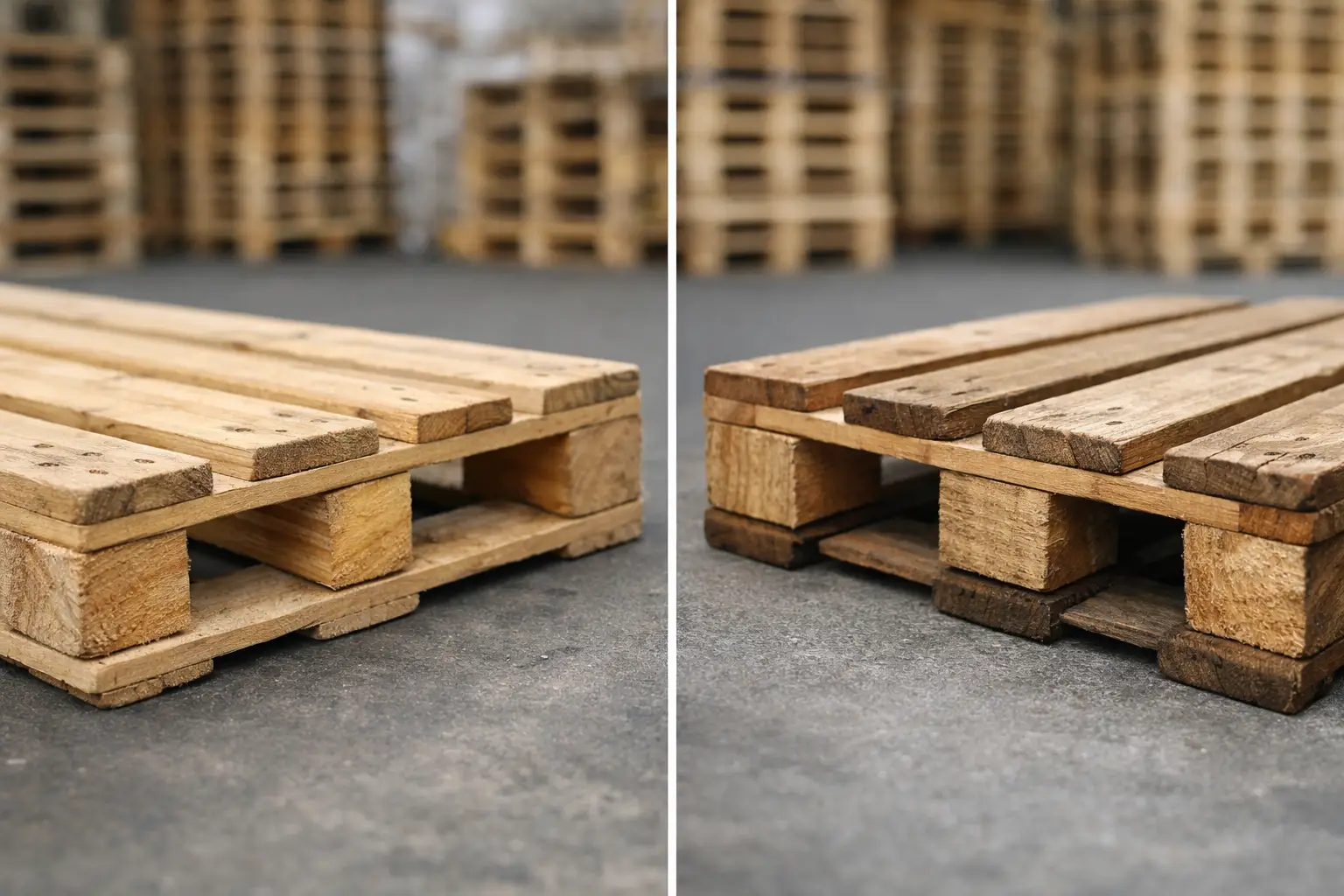
New EPAL pallets start from €16.20, used from €7.00, and new UIC pallets are on request. Order on +359 877 166 555 or via Viber/WhatsApp.
We reply to every inquiry with a price within 15 minutes.
EPAL and UIC pallets are the same size (1200 × 800 × 144 mm). The difference lies in the marking and in whether they are accepted for exchange. Most retail chains require EPAL, as does 1-for-1 exchange, while new UIC pallets are a cheaper option for internal circulation. G-PAL sells both types from its warehouse in Plovdiv.
Updated: 12 October 2026 · G-PAL (Dzhipal Ltd), Plovdiv
When a standard euro pallet comes up in warehousing, transport or procurement, people often assume that all 1200 x 800 pallets are the same. In practice, there is a difference between EPAL and UIC pallets, and it goes beyond the stamp on the timber. For a business that loads every day, exports goods or works within an exchange scheme, this difference has a direct bearing on whether a load is accepted, what replacements cost and how predictable your logistics are.
What is the difference between EPAL and UIC pallets?
The short answer is this: both types are linked to the European standard for euro pallets, but they are not the same in terms of organisation, marking and practical acceptance on the market. EPAL pallets are manufactured and inspected within the EPAL licensing system. UIC pallets are tied to the older railway standard and to the requirements historically used in pallet exchange across Europe.
On the ground, this means customers look at more than just the size. They check whether the pallet carries the correct marks, whether it is eligible for exchange, whether a partner or freight forwarder will accept it and whether its condition suits the specific operation. That is where the real difference begins.
The size is the same, but that doesn’t settle it
Both EPAL and UIC pallets are usually the standard size of 1200 x 800 mm. Both are designed for use with forklifts, pallet trucks, racking systems and groupage or full loads. If you look only at the external dimensions, it is easy to come away thinking it makes no difference which one you buy.
In many cases, however, size is only the starting point. For companies with strict exchange requirements, international transport or controlled warehouse procedures, precise identification of the pallet matters. If the recipient expects a licensed EPAL pallet with traceable marking, a pallet with similar specifications but different markings can lead to a dispute, a delay or a rejection.
Marking is the first visible difference
The easiest way to tell EPAL and UIC pallets apart is by their markings. On EPAL pallets you will normally see the oval EPAL logo on the right-hand corner block and, depending on the production period and licence, additional marks relating to the manufacturer, heat treatment and inspection.
UIC pallets carry markings associated with the old way of labelling EUR pallets under the railway standard. There are also pallets on the market that look like euro pallets but whose marking is insufficient or incorrect. This is a critical point when buying used pallets, because good outward condition does not always mean the pallet is suitable for exchange or export.
For buyers, the rule is simple: don’t buy from a photo, and don’t assume that every 1200 x 800 pallet is equivalent to an EPAL.
Quality control is not a formality
The EPAL system has clearly defined licensing and quality control. This brings greater predictability in terms of construction, dimensions, load capacity and permitted tolerances. For B2B customers this matters, because a pallet is not just a carrier. It is part of the entire unit load, part of safe storage and part of smooth acceptance at the customer’s end.
UIC pallets can be a perfectly workable solution, especially for certain flows, local movement of goods or price-sensitive operations. But when your partner explicitly requires EPAL, compromising is rarely worth it. Savings at the outset can easily turn into the cost of returns, reloading or replacement.
There is one more nuance here. With used pallets, the grade is just as important as the type. A light-grade, sound and properly repaired used EPAL pallet is often a better choice than a cheap pallet of questionable origin with unclear marking.
Difference between EPAL and UIC pallets in exchange
If your company takes part in euro pallet exchange, this is not a theoretical question. There is a difference between EPAL and UIC pallets in exchange, because acceptance depends on the rules of the specific counterparty, country, network or transport scheme.
In practice, the most sought-after pallet is one that is easily recognisable, standard and free of any doubt about its identification. EPAL is generally accepted more readily in modern exchange processes precisely because of its clear licensing and inspection system. This doesn’t mean that every UIC pallet is unusable. It means you need to know in advance what the other party requires.
With domestic deliveries or long-standing partners there is often more flexibility. In international transport, and especially where acceptance procedures are stricter, surprises cost more. So the right question is not which pallet is “better” in principle, but which pallet will be accepted without question in your particular flow.
When to choose EPAL
EPAL is the sensible choice when you want maximum predictability. This applies to exports, regular exchange, work with large logistics operators, centralised warehouses and customers with precise requirements for load carriers. If your company follows standardised procedures and cannot afford a dispute at the loading bay, EPAL gives you greater certainty.
It is also the right choice when consistency between batches matters to you. At larger volumes, this affects stacking in racking, automated processes and delivery traceability. Of course, the price may be higher than less demanding alternatives, but for many companies this is a manageable cost in exchange for lower operational risk.
When a UIC pallet may be enough
A UIC pallet may be perfectly adequate for internal logistics, local deliveries or cases where the counterparty has no explicit requirement for EPAL. If the pallets are used in a closed loop, come back to you and do not enter a sensitive exchange scheme, overall condition and strength may matter more than the specific marking system.
This is a common scenario at production sites, warehouses and construction sites, where the pallet serves a purely practical function. In such cases the choice is driven by budget, availability and load rather than by the licensing framework. But there is a condition here too: the pallet must be fit for use, properly repaired and suitable for the actual load.
How to avoid mistakes when buying
The most common mistake is buying pallets on price alone. With standard sizes the temptation is strong, because at first glance the differences seem small. Then come rejected pallets, breakages during loading, exchange problems and extra journeys.
A safer approach is to start from the application. Will the goods be exported? Will the pallets be part of an exchange? Does the customer require specific marking? What is the load – heavy, fragile, stacked high? Are new or used pallets better suited to your flow? Once these questions are answered, choosing between EPAL and UIC becomes much easier.
It is also important to work with a supplier who can offer consistent availability, clear grading and genuine advice, not just volume. For companies with regular deliveries, this is worth more than a one-off low price. In practice, it is consistency that saves the most money.
New or used – it depends on the operation
The difference between EPAL and UIC pallets is often discussed separately from condition, but the two topics are linked. A new pallet offers maximum reliability and a good appearance, which matters for exports, food, pharmaceuticals or customers with stricter standards. A used pallet is a cost-effective solution when it has been properly sorted and suits the specific way you operate.
In a well-run warehouse, not every load needs a new pallet. But not every load can tolerate a compromise either. So the right choice is not the cheapest one, nor necessarily the most expensive. The right choice is the one that fits your actual operation without unnecessary risk.
For companies in Plovdiv and across the country working with regular volumes, the most practical approach is to clarify their requirements in advance and maintain a reliable supply channel. That way, the pallet doesn’t become the last-minute problem before loading, but stays what it should be – a dependable base for every shipment.
If you are torn between EPAL and UIC, don’t choose out of habit. Choose according to what the customer will accept, what the load will bear and what will spare you problems at the loading bay tomorrow morning.
Frequently asked questions
Are EPAL and UIC pallets the same size?
Yes, both are 1200×800×144 mm.
Which pallet do retail chains require?
Usually EPAL, because it is exchanged 1 for 1.
Which one is cheaper?
A new UIC pallet is usually cheaper than a new EPAL. The price is for the day – +359 877 166 555.
Do you repair EPAL pallets?
Yes, under official EPAL licence BG-308.
How much do EPAL and UIC pallets cost?
New EPAL pallets start from €16.20, used dark-grade EPAL from €7.00 and light-grade from €11.00. New UIC pallets are on request. The exact price for the day depends on the grade and quantity.
See also: EPAL pallets, UIC pallets, new EPAL, new UIC.
📞 Call: +359 877 166 555 · Viber · WhatsApp
See also: EPAL pallets, new euro pallets, today’s pallet prices.
Updated: 09.11.2026
About the author
depal
Pavel Damyanov is the manager of DZHIPAL Ltd (G-PAL) - a manufacturer and supplier of euro pallets, wooden skids and pallet collars based in Plovdiv, 270 Vasil Levski Blvd. The company is a licensed EPAL pallet repair operator (licence No. BG-308), buys back pallets and skids on site and delivers nationwide with its own transport.
Published on 26 April 2026
Need today's price? Tell us the pallet type, quantity and city and we will reply with today's price.
Request a price
