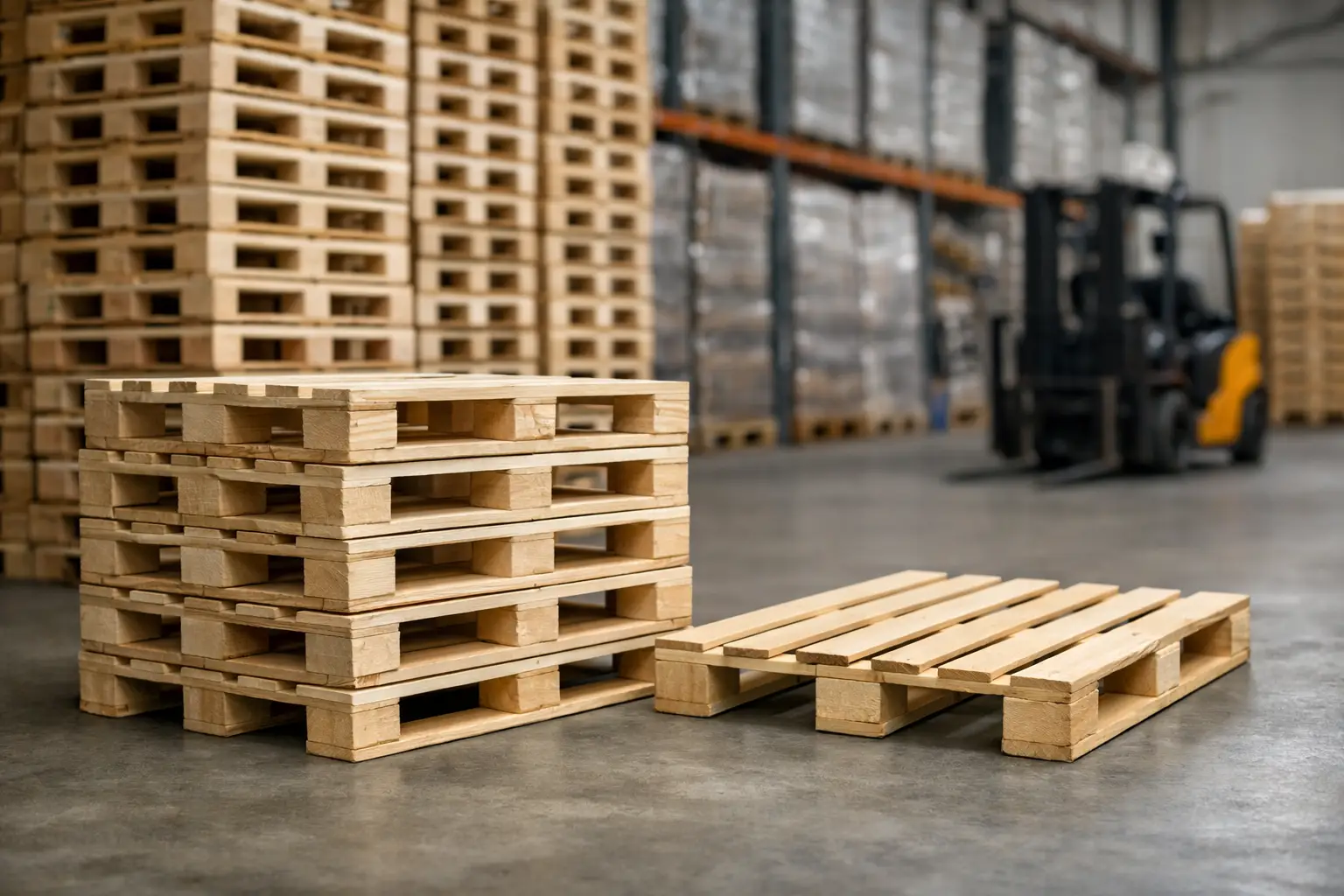
New or used? The honest answer is that it depends on where the pallet goes and what it carries. A used pallet that never comes back saves real money; a used pallet in a food plant or an automated warehouse creates a problem that costs far more than the saving. Here is how to decide, and what to check before you pay.
When a used pallet is the right choice
- One-way transport — the pallet goes out with the goods and is not coming back.
- Internal circulation between racks and zones inside your own warehouse.
- Storage under load, where the pallet is moved rarely.
- Construction and production sites, where appearance is irrelevant and damage is likely anyway.
When a new pallet is worth it
- Food and pharmaceutical work, where hygiene requirements rule out unknown history.
- Automated warehouses, where the handling equipment needs millimetre-consistent dimensions.
- Customer contracts that specify a pallet quality.
- Heavy or expensive cargo, where the pallet is a rounding error against the value of the load.
- Non-standard sizes, which simply are not available second-hand in quantity.
The grades of used pallets
| Grade | Condition | Typical use |
|---|---|---|
| A (white) | Light-coloured wood, no repairs, clean and unbroken | Food, export, anything presentable |
| B (brown) | Darkened wood, workshop-repaired, all elements sound | General transport and storage |
| C | Visibly worn and repaired, but structurally sound | Internal movement and storage |
Grades are descriptive, not legally defined, so ask the supplier what they mean by them and, better, look at the stack.
What to check before you buy
- The blocks. Cracked or broken blocks are the usual cause of a collapsed stack.
- The load-bearing boards. A crack running along the grain is a defect, however small it looks.
- The nails. Protruding heads tear stretch film and damage goods.
- Moisture and mould. Refuse them whatever the price; they will not dry out into good pallets.
- The stamp. On an EPAL pallet it is on the corner blocks; check it is there and legible.
- Consistency across the batch. Pull units from the middle of the pile, not the two on top.
The real arithmetic
Comparing the price per pallet is the wrong comparison. Four things decide the actual cost:
- How many cycles it survives. A new pallet that lasts three times as long is not more expensive.
- The reject rate in a used batch. Ten per cent unusable changes the effective unit price immediately.
- The distance it travels to you. Transport is often a bigger line than the discount you negotiated.
- The risk to the cargo. One pallet failing under an expensive load erases a year of savings.
Buying in bulk
The best prices go to customers who take deliveries on a regular schedule, because a supplier can plan production and sorting around a known volume. If your consumption is steady, say so when you ask for a quote — it is worth more than haggling over a single load.
Talk to us about quantities
G-PAL supplies new and used euro pallets in every grade, from single loads to regular contracts. Call +359 877 166 555 or email [email protected]. See the current pallet range.

