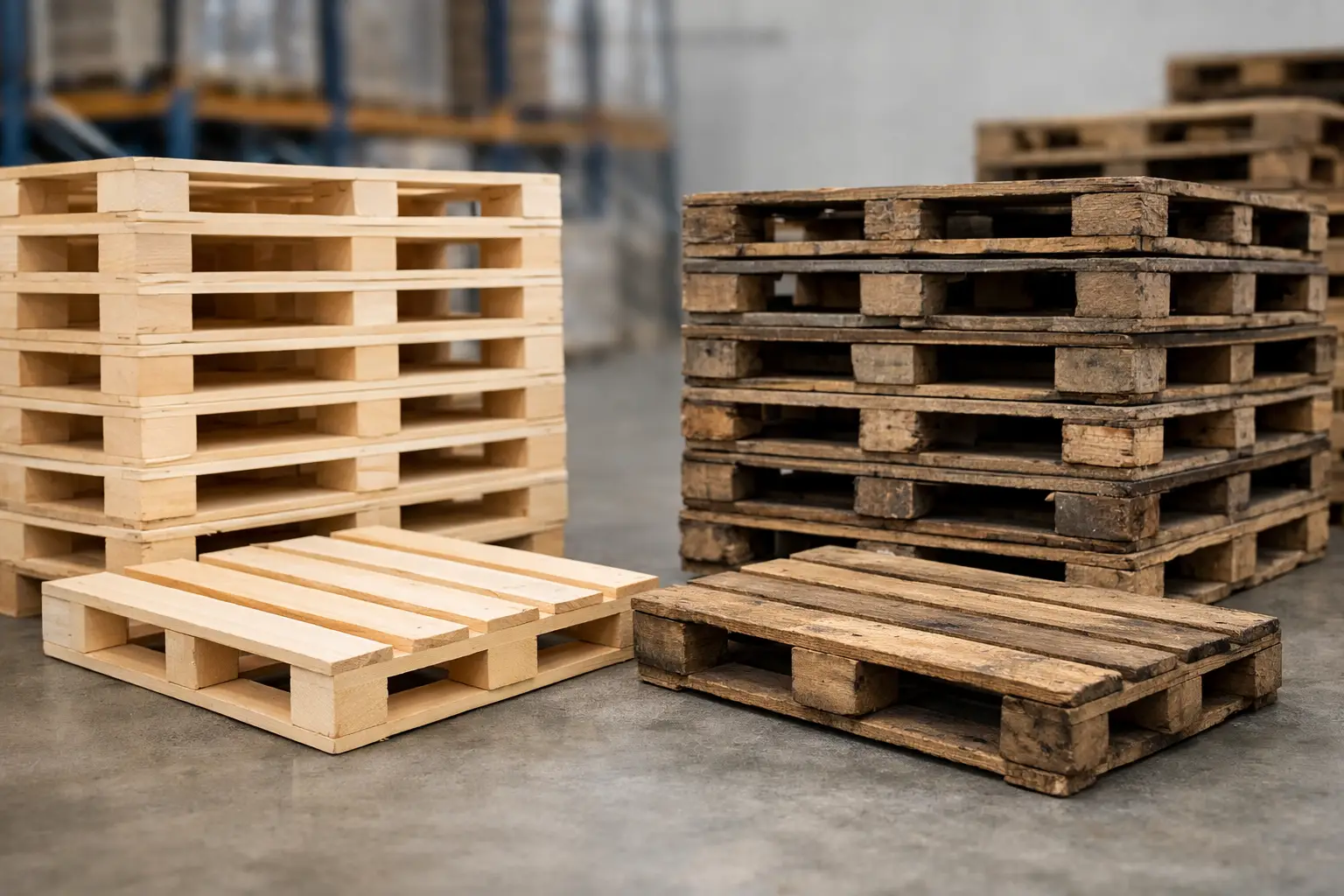
Used EPAL pallets from €7.00, new EPAL from €16.20 – order on +359 877 166 555 or via Viber/WhatsApp.
Choose new pallets for retail chains, export and food; go for used ones when you need a cheap, sturdy pallet for warehousing or a one-off shipment. Among used pallets, light grade ones show less wear, while dark grade ones are the cheapest. G-PAL stocks both types in Plovdiv and also buys back your old pallets.
Updated: 12 October 2026 · G-PAL (Dzhipal Ltd), Plovdiv
When a warehouse is running under pressure, choosing pallets is not a minor expense but an operational decision. The question of new vs used pallets usually comes down to three things: price, reliability and the specific application. If the load is sensitive, if you export, if turnover is high or if pallets frequently go missing, the right choice looks different.
The most common mistake is buying on unit price alone. A cheaper pallet does not always work out cheaper in day-to-day use, just as a more expensive one does not always deliver more value. That is why the choice should be based on the load, how often the pallets are used, your customer’s requirements and how the goods move.
New vs used pallets – what you are really comparing
At first glance, the comparison is simple. A new pallet comes with a clean appearance, consistent dimensions, a predictable condition and a longer remaining service life. A used pallet comes at a lower price and is often perfectly adequate for internal logistics, short-haul transport or one-off shipments.
The real difference, however, is not just whether the pallet is new. What matters is the grade, the load capacity, the condition of the boards, the strength of the blocks, the quality of the assembly and whether the pallet meets the standards your customer or haulier requires. With EPAL and UIC pallets this is especially important, because the standard is not a formality but a guarantee of compatibility in transport and storage.
So the right question is not “new or used?” but “what job will the pallet do, and how predictably does it need to perform in the process?”
When new pallets are the better option
New pallets are a sensible choice when you handle regular loads, high turnover and clear quality requirements. If you run automated lines, racking systems, regular deliveries to large customers or export, a new pallet reduces the risk of deviations and stoppages.
The same applies when appearance matters. In certain sectors – food production, pharmaceuticals, cosmetics, white goods, export of finished products – a clean, uniform pallet is not a detail but part of the delivery standard. The recipient often judges not only the goods but also how they arrive.
There is also a purely financial logic. A new pallet costs more up front, but if it is reused many times, stored properly and not lost along the supply chain, its cost is spread over time. For companies with a closed internal flow, this is often the more cost-effective scenario.
Another important case is pallets compliant with ISPM 15 (Standard 15) for international trade. Where heat treatment and traceable origin are required, a new pallet often makes organisation easier and leads to fewer disputes during loading and acceptance.
The advantage of predictable quality
With new pallets you have greater control over the quality of the batch. Dimensions, timber moisture, strength and overall condition are more consistent. This matters when a single weak pallet can hold up forklift traffic, damage goods or cause problems when loading a truck.
For companies working to a schedule that cannot afford delays, predictability is often worth more than a lower initial price.
When used pallets are more cost-effective
Used pallets have a clear place in business. For internal warehouse movements, short rotations, temporary loads and goods with no special requirements, they are often the most practical option. If a pallet is not going to complete a long cycle, there is no point always paying for a new one.
This is particularly true for companies with a high monthly pallet consumption, where some of the pallets never come back. In that case, a low purchase price has a direct impact on the budget. Rather than investing in an asset that will leave the system with the very first delivery, many companies opt for quality used pallets in good commercial condition.
In construction, heavy-duty logistics, materials storage, temporary sites and internal stock movements, a used pallet often does the job without unnecessary expense. The key is not to confuse “used” with “second-rate”. Well-selected, inspected pallets can perform reliably, provided they are suited to the load.
A lower price – but not at any cost
This is where the nuance comes in. If a used pallet is cheap but has loose components, cracked boards or uneven geometry, the savings quickly disappear. A single broken pallet can mean damaged goods, lost time and extra labour restacking.
That is why, when buying used pallets, checking their condition matters most. Look not simply for a low price, but for fitness for real-world use. For serious B2B customers, that is the more useful criterion.
How to choose according to the application
If you ship goods to retail chains, production sites or international partners, new pallets generally give a more reliable result. They are also better suited to heavier loads, stricter stacking requirements and longer logistics routes.
If the pallets stay on your premises, move between sites or are used for short-term operations, used pallets are often the more sensible choice. They can reduce costs without putting a strain on the process, as long as they are properly selected.
There is also a middle way. Many companies use a mix – new pallets for export, key customers and sensitive loads, and used ones for internal flow and standard deliveries. This is usually the most practical model, as it combines control with efficiency.
New vs used pallets in terms of real costs
For a buyer or manager, what matters most is the total cost of use. This includes not just the purchase, but also breakages, losses, rejects, replacements, return logistics and the team’s time. New and used pallets need to be assessed against the actual flow of goods, not just the quote.
The example is simple. If you buy a more expensive pallet that lasts more cycles and causes no problems during loading, it may turn out to be the better deal. But if the pallet will leave the system with the very first delivery, the lower price of a used one makes more sense.
The same goes for seasonal peaks. When orders surge, you do not always need to drive up costs with brand-new pallets. For temporary volumes, it is often more practical to use second-hand pallets and keep the new ones for your regular channels.
What to check when buying
Whether you choose new or used pallets, there are a few critical questions. What is the exact size, what load will they carry, will they be used in racking, is EPAL or UIC required, is ISPM 15 (Standard 15) needed, and how often will they turn over?
With used pallets, also check their overall condition. Are there cracks, missing components, signs of moisture or instability? With new pallets, check whether you get consistency between batches and whether the supplier can maintain stock for larger orders.
For companies in Plovdiv and the surrounding region, this is often decisive. When the supplier is close by, response times are quicker, transport is easier and top-up quantities arrive without unnecessary delay. This is exactly where a reliable partner makes the difference – not just on price, but in being able to keep pace with your business.
There is no universally right choice
When it comes to new vs used pallets, there is no one-size-fits-all answer. If your business prioritises standards, presentation and long service life, new pallets are the logical step. If you want to keep costs under control in internal logistics, or for pallets with a high risk of loss, used pallets are often the better option.
The best decision is usually the one tailored to your specific flow of goods rather than a general rule. In practice, the winner is not the one who buys cheapest, but the one who buys right. If you want your choice to work in your favour in the long run, treat the pallet as part of your logistics rather than an ordinary consumable.
Frequently asked questions
Which is more cost-effective?
For internal warehousing, usually used pallets. For retail chains and export, new ones.
What are light and dark grade pallets?
Light grade pallets show less wear and cost more; dark grade pallets are more worn and cheaper.
How much do they cost?
The price is for the day and depends on the type, grade and quantity. We can quote it straight away on +359 877 166 555.
New EPAL pallets are from €16.20, used EPAL light grade from €11.00, medium grade from €10.00, dark grade from €7.00, and euro skids 120×80 from €4.20. The exact price for the day depends on grade and quantity – we can quote it straight away on +359 877 166 555.
See also: new euro pallets, used pallets, used pallet prices.
📞 Call: +359 877 166 555 · Viber · WhatsApp
See also: new euro pallets, used pallets, today’s pallet prices.
Updated: 10 November 2026
About the author
depal
Pavel Damyanov is the manager of DZHIPAL Ltd (G-PAL) - a manufacturer and supplier of euro pallets, wooden skids and pallet collars based in Plovdiv, 270 Vasil Levski Blvd. The company is a licensed EPAL pallet repair operator (licence No. BG-308), buys back pallets and skids on site and delivers nationwide with its own transport.
Published on 9 May 2026
Need today's price? Tell us the pallet type, quantity and city and we will reply with today's price.
Request a price
