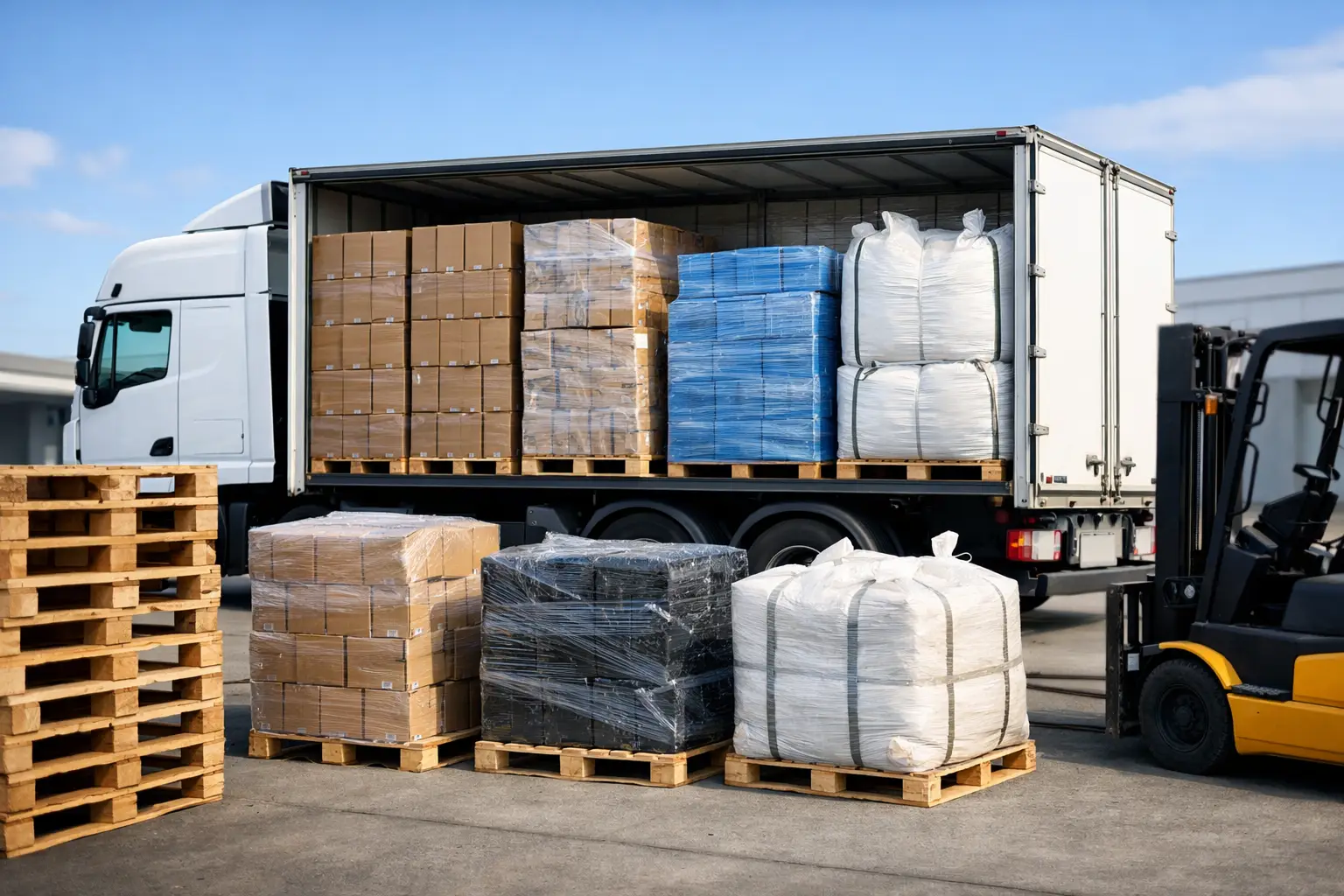
Euro pallets for loading start from €7.00 (used dark-grade EPAL) and from €16.20 (new EPAL) – tell us the quantity on +359 877 166 555 and we will give you a price including delivery.
When you need to arrange a delivery, the question “how many pallets fit in a lorry” is not just about the count. It determines the cost of transport, the choice of vehicle, the dispatch date and the risk of unpleasant surprises at loading. For a standard load of euro pallets the answer is usually 33 pallets, but the real capacity always depends on size, weight and how the load is arranged.
How many standard euro pallets fit in a lorry?
A standard curtainsider or box semi-trailer has an internal length of around 13.60 m and an internal width of around 2.45 m. With euro pallets measuring 1200 x 800 mm, the usual capacity is 33 euro pallets in a single row on the floor.
This layout comes from three pallets across the width and eleven rows along the length. The pallets are placed with the 800 mm side across the width of the trailer and the 1200 mm side along its length. Three pallets take up 2.40 m of width, and eleven rows take up 13.20 m of length. This leaves a small working gap for safe loading and securing.
These 33 spaces are the practical starting point when booking transport for EPAL pallets. They do not automatically mean that the trailer can take any load on 33 pallets. Total volume and permitted weight must be considered together.
Can 34 euro pallets be loaded into a lorry?
Loads of 34 euro pallets are sometimes seen, arranged in a mixed pattern or in a trailer with slightly different internal dimensions. However, this is not a standard you can sensibly rely on when planning. Turning pallets in different directions can complicate loading, reduce stability or leave too little room for securing the load.
For regular deliveries it is safer to calculate on 33 standard euro pallets on the floor. If you have 34 pallets or non-standard dimensions, agree the layout in advance with the haulier and the pallet supplier. That way, none of the goods will have to wait for the next run.
Capacity by pallet size
The size of the load carrier changes capacity noticeably. The most common euro pallet is 1200 x 800 mm, but manufacturing, retail and construction also use 1200 x 1000 mm pallets, as well as non-standard wooden skids.
With 1200 x 1000 mm pallets, a standard 13.60-metre semi-trailer usually takes 26 pallets. Two pallets sit across the width and thirteen rows along the length. This is a typical example of why it is not enough simply to say “we have a lorry-load of pallets”. The exact size must be clear as well.
For non-standard pallets, capacity is calculated individually. Length and width are the key factors, but overhang of the goods, the shape of the packaging, whether the pallet can be turned and the need to keep different batches apart all matter too. A 1200 x 1200 mm pallet, for example, takes up considerably more usable floor space, even when the load is low.
Good practice is to state the pallet size, quantity, height of the goods and approximate weight per pallet in your enquiry. This allows an accurate transport quote rather than an estimate that has to be corrected later.
Weight often matters more than the number of pallets
A standard semi-trailer can carry roughly up to 24 tonnes of payload, but the actual permitted weight depends on the combination, the unladen weight of the tractor unit and trailer, the route and legal limits. So 33 pallets do not always mean a full load.
If one pallet weighs 800 kg, 33 pallets would reach 26,400 kg. In that case the load could not travel on one standard lorry, even though it physically fits on the floor. You would need to reduce the number of pallets, use more runs or choose a suitable solution for the load.
The opposite case is also common. Light but bulky products can fill all 33 spaces without coming close to the maximum permitted weight. For transport pricing, however, they still occupy the whole trailer. When planning groupage or full-truckload transport, you need to account for both kilograms and pallet spaces.
Load height and double stacking
The internal height of a standard trailer is usually around 2.65–2.75 m. If the goods allow pallets to be safely stacked on top of one another, the number of pallets carried can increase. In theory, 33 pallets on the floor can become 66 pallets when double-stacked.
This is only an option when the packaging and goods are designed for such loading. Cartons, sacks, bottles, machinery, unstable pallets or goods in fragile packaging should not be stacked two high just to save on transport. Pressure on the bottom row, the risk of slipping and the limited height must be checked in advance.
For pallet collars, light packaging materials or certain mass-produced products, double stacking can make economic sense. For heavy industrial goods, the limit is usually weight rather than free height.
What does a loading metre mean?
When you are not filling a whole lorry, logistics companies often work in loading metres, also known as LDM. One loading metre means the full width of the trailer taken up over one metre of length.
In a standard layout, three euro pallets in one row take up approximately 0.40 loading metres. So 33 euro pallets take up about 13.20 loading metres of the trailer. A 1200 x 1000 mm pallet, loaded two to a row, usually takes up about 0.50 loading metres per pair of pallets.
This calculation is useful for groupage consignments, but it is not an absolute formula. If the pallets cannot be placed side by side, have overhang or must be kept separate from other goods, the space actually taken up may be greater. The loading metre is therefore a planning tool, not a substitute for exact dimensions.
The type of trailer also matters
In everyday practice, the word “TIR” is most often used for a standard tractor unit with a semi-trailer. Technically, TIR is a customs transit system, not a size of lorry. For capacity, however, what matters is the actual type of vehicle.
A standard curtainsider is the most flexible option for palletised loads, as it allows side, rear and often top loading. A mega trailer offers greater internal height and suits tall but not overly heavy pallets. A refrigerated trailer often has slightly different internal dimensions because of the insulation and the refrigeration unit. With a rigid truck and drawbar trailer, a van or a flatbed vehicle, the capacity is entirely different.
If your load is specific, do not simply ask for “one lorry”. State whether side loading is needed, whether there is a forklift on site, whether the pallets can be double-stacked and whether the goods need protection from moisture. These details determine the right vehicle.
How to prepare pallets for safe transport
The right number of pallets is worthless if the load is not stable. The base must be sound, with no broken boards, loose nails or badly damaged blocks. For exports outside the EU, or where the customer requires it, use pallets treated to ISPM 15 (Standard 15) with the required marking.
The goods should not extend beyond the outline of the pallet unless this has been agreed in advance. Overhang prevents tight loading and increases the risk of damage during manoeuvres. Stretch film, strapping, corner protectors and proper securing in the trailer protect both your goods and the rest of the load.
With mixed consignments, the layout must take account of the unloading order. Pallets for the first drop should not be blocked behind goods for a later address. This is especially important for deliveries to several warehouses or retail outlets.
A practical approach before booking transport
The quickest way to get an accurate answer is to prepare four pieces of information: number of pallets, base size, height including the load, and weight per pallet. Add the loading and unloading addresses, the preferred date and whether a forklift is available. That way you will find out not only whether the load fits, but whether it can be loaded safely and at a good price.
For standard EPAL pallets, take 33 spaces in a standard lorry as your working basis. Then check the weight, whether double stacking is possible and the particular features of the goods. With non-standard sizes, working it out in advance saves time, an extra run and unnecessary costs.
If you are supplying pallets or arranging a load from Plovdiv and the surrounding region, GPAL can help with suitable new or used pallets and a practical assessment of the number of pallet spaces you need. Accurate information before loading is the surest way for the transport to leave on time and for the load to arrive in the agreed condition.
Frequently asked questions
How much does one euro pallet for loading cost?
Used dark-grade EPAL starts from €7.00, light grade from €11.00 and new EPAL from €16.20. The exact price for the day depends on the grade and quantity; for a full lorry-load, tell us the quantity and we will give you a price including delivery.
How long is a lorry?
A standard semi-trailer (curtainsider or box) has an internal length of around 13.60 m and a width of around 2.45 m – which is why 33 euro pallets of 1200×800 fit in a single row.
How many tonnes can a lorry carry?
Around 24 t of payload, but the exact permitted weight depends on the haulier and the route. 33 pallets at 800 kg each come to 26,400 kg – more than can be loaded, so with heavy goods not all the spaces are filled.
Can you deliver a full lorry-load of euro pallets?
Yes – used EPAL starts from €7.00 and new from €16.20. Tell us the quantity and address on +359 877 166 555 and you will receive a price including delivery.
See also: euro pallet dimensions and weight, today’s pallet prices, pallet delivery.
Updated: 9 November 2026
See also: euro pallet dimensions and weight, wholesale pallets, pallet delivery.
About the author
depal
Pavel Damyanov is the manager of DZHIPAL Ltd (G-PAL) - a manufacturer and supplier of euro pallets, wooden skids and pallet collars based in Plovdiv, 270 Vasil Levski Blvd. The company is a licensed EPAL pallet repair operator (licence No. BG-308), buys back pallets and skids on site and delivers nationwide with its own transport.
Published on 22 July 2026
Need today's price? Tell us the pallet type, quantity and city and we will reply with today's price.
Request a price
