New EPAL pallets from €16.20, used EPAL from €7.00 – tell us which country the shipment is going to on +359 877 166 555 or via Viber/WhatsApp.
“Standard 15” for pallets is the international standard ISPM 15: the wood is heat-treated so that it cannot carry pests, and the pallet bears an IPPC stamp with BG, the manufacturer’s number and HT. You need it when exporting outside the EU. G-PAL supplies Standard 15 pallets from certified manufacturers and delivers them with its own transport.
Updated: 12 October 2026 · G-PAL (Dzhipal Ltd), Plovdiv
When the goods are ready to ship and the truck is waiting to be loaded, the last thing any business wants is a problem at the border because of the wooden packaging. That is exactly why the question of what Standard 15 means is no mere formality. It has a direct bearing on whether your pallets and wooden packaging materials are fit for international transport and whether they will be accepted without delay.
For companies in manufacturing, logistics, trade and export, this is no minor detail. If you use wooden pallets, skids, crates or load-securing components, you need to know when ISPM 15 treatment is required, how to recognise it and what risks you run without it.
What Standard 15 means
“Standard 15” most often refers to the international phytosanitary standard ISPM 15. It governs the treatment of wood packaging material used in international trade. The aim is simple – to limit the spread of pests and diseases through untreated wood.
The standard applies to wooden pallets, pallet collars, crates, cases, dunnage and other packaging made from solid wood. When this material crosses borders, in many cases it must be treated according to an established procedure and marked in line with the requirements.
In practice, this means two things. First, the wood must undergo an approved treatment, most commonly heat treatment. Second, the item must carry an official mark showing that the procedure was carried out by a registered manufacturer.
Why the standard matters for your business
For domestic deliveries within Bulgaria, this question often takes a back seat. But once you export or work with international customers, the standard quickly becomes decisive. If the load sits on pallets without a valid mark, the result can be delays, rejected deliveries, extra costs and even destruction of the packaging under local rules.
The risk is not purely administrative. In supply chains with tight deadlines, every slip in documentation or packaging causes a real operational loss. A single wrong choice of pallet can hold up an entire shipment, especially when exporting to markets with stricter controls.
So for buyers, warehouse managers and transport coordinators, the right question is not just “Are there pallets available?” but “Are they suitable for this particular route and customer?”
How the Standard 15 requirement is met
The most widely used method is heat treatment. The wood is heated to a set temperature for a set time in order to eliminate pests and larvae. The material is then marked with an official stamp.
Typically, the pallet or wooden component is marked with the country code, the manufacturer’s registration number and a code for the treatment method. Most often you will see the abbreviation HT, which indicates heat treatment.
It is important to know that not every mark is sufficient on its own. It must be legible, correctly applied and come from a licensed manufacturer or treatment facility. If the stamp is unclear, partly worn away or questionable, that too can cause problems.
What should not be confused with Standard 15
It is often assumed that any wooden pallet automatically meets the requirements if it looks sound or is new. That is not the case. A new pallet is not necessarily ISPM 15 treated, and a used one is not necessarily unsuitable. What counts is the actual treatment and a valid mark.
Another common mistake is to assume that the standard is the same as a standard pallet size or type, such as EPAL or UIC. These are different things. Size, construction and load capacity are one matter. Phytosanitary treatment for international transport is another.
In other words, a pallet can be standard in size but unsuitable for export. Conversely, a non-standard pallet can be entirely acceptable for international use if it has been manufactured and treated to the requirements.
When Standard 15 is mandatory for pallets
There is one important caveat here – it depends on the destination and the mode of transport. In most cases the standard is required for international shipments with packaging made from solid wood. If you are sending goods abroad, it is unwise to make assumptions. You need to check the requirements of the market, the customer and the carrier.
For exports outside the European Union, the requirement is especially common. But even within Europe, customers may have specific commercial or logistical requirements. Some companies work only with treated and marked pallets, even where the route does not explicitly require it by law.
There are exceptions, too. Packaging made from processed wood such as plywood, OSB, MDF and other engineered materials usually falls outside these rules, because it does not carry the same phytosanitary risk. That does not mean, however, that every mixed packaging is automatically exempt. If the construction includes solid wood, the requirement may still apply.
How to check whether a pallet complies
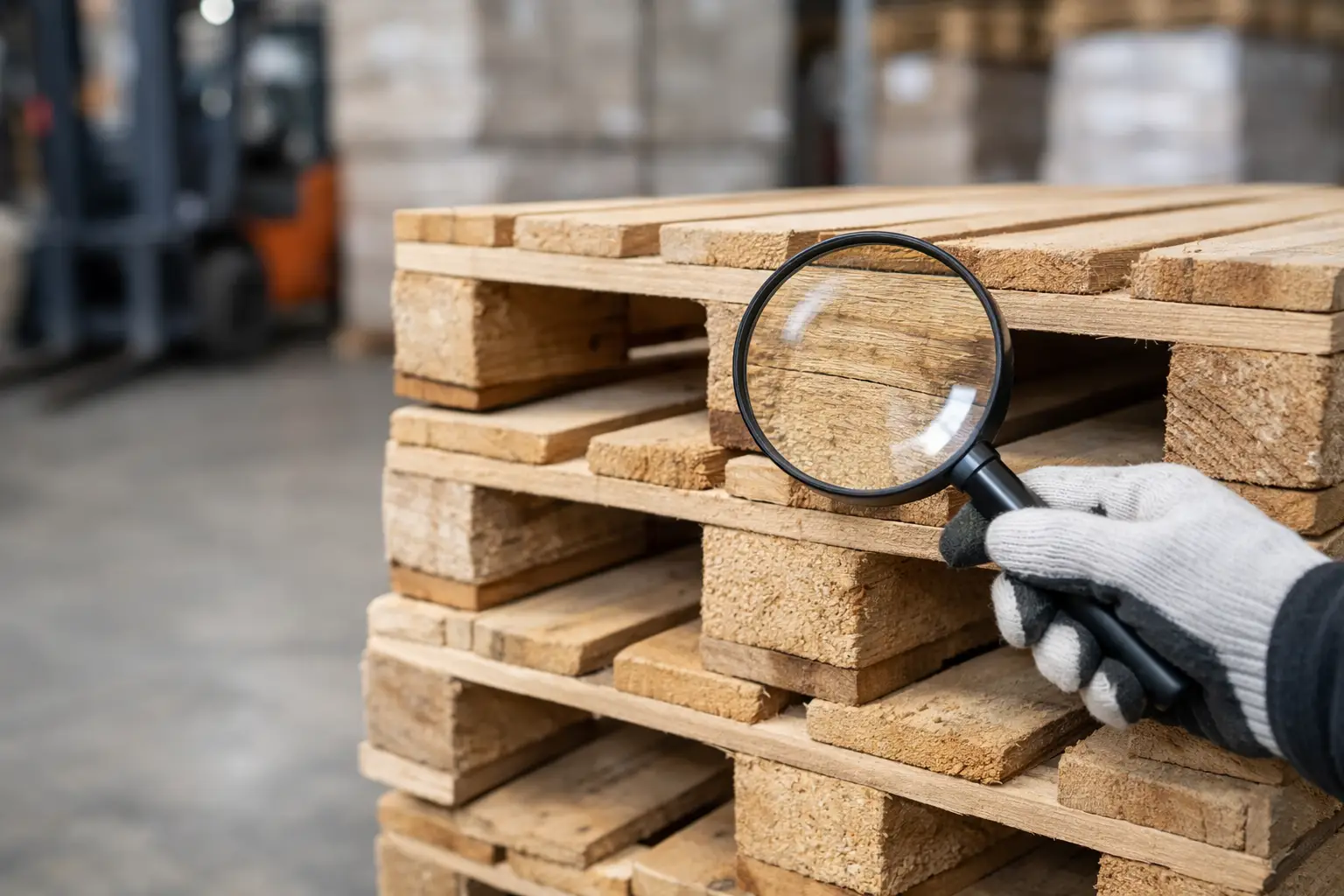
The first step is a visual check of the mark. It should be clear, durable and placed in a suitable position. If the pallet has been repaired, reused many times or painted, the check needs to be even more careful.
The second step is the origin. When you work with a supplier who understands the commercial and logistical requirements, the risk of misunderstandings is lower. With large volumes and regular deliveries this matters, because a single mistake can be repeated across an entire batch.
The third step is to match the pallet to the specific application. If you are shipping heavy loads, the stamp alone is not enough. You also need the right construction, a suitable size, good load capacity and sound condition. Standard 15 covers the phytosanitary side, but it does not automatically cover every requirement for the packaging.
What are the risks of the wrong choice
The most obvious risk is the shipment being stopped. This leads to downtime, extra transport, reloading and friction with the customer. On some deliveries, the cost of the delay is higher than the cost of the pallets themselves.
There is also a quieter risk – poor predictability. If some of the pallets carry a valid mark and others do not, logistics become unreliable. The warehouse works with mixed stock, teams are unsure which pallets can be loaded for export, and time is lost at the last minute.
That is why there is only one reliable approach – plan according to the route and work with a supplier who can provide consistent stock, clear traceability and accurate information about the treatment. For companies with regular dispatches, this is not a convenience but a necessary discipline.
What Standard 15 means when working with a supplier
When you are looking for export pallets, you are not simply ordering a wooden product. You are ordering compatibility with a specific logistics task. That covers treatment, marking, size, quantity, lead time and often transport to your site.
Good practice is to ask a few clear questions right at the start: which country the shipment is for, what kind of load it is, whether new or used pallets are required, and whether a non-standard size is needed. That way the supplier can offer a solution rather than just stock.
This is exactly where certified Standard 15 production delivers real value. It gives you more certainty when you are working to a deadline and do not want to compromise on documents or quality. For companies that load every day, it saves checks, returns and needless last-minute conversations.
When it pays to think beyond the standard itself
Sometimes the question is not only whether the pallet meets the requirement, but whether the whole packaging set-up is optimal. If you export frequently to different markets, it may be more cost-effective to standardise internally on treated pallets only, rather than splitting stock between the domestic and export markets.
In other cases, that is not the best solution. If you work mainly within the country and only occasionally ship abroad, the more flexible option is a separate stock for export. It depends on the volume, frequency and price sensitivity of the business.
It also matters whether you use new or used pallets. Used pallets are often better value, but they must be in good condition and have a legible mark if they are to be used for international transport. New pallets offer more predictability, but they are not always mandatory. The decision here should be commercially sensible rather than automatic.
Once you know what Standard 15 means, choosing pallets becomes easier and safer. You are not just buying a wooden carrier for your goods, but peace of mind along the whole chain – from the warehouse to unloading.
Questions about Standard 15
Are Standard 15 and ISPM 15 the same thing?
Yes. “Standard 15” is the colloquial name for the international phytosanitary standard ISPM 15 for wood packaging material.
What does the Standard 15 stamp say?
The IPPC symbol, the country code (BG for Bulgaria), the manufacturer’s number and HT for heat treatment.
Is Standard 15 required for transport within Bulgaria or the EU?
Usually not. It is required for exports outside the EU or when the customer explicitly asks for it.
How do I order Standard 15 pallets?
Tell us the quantity, size and destination country on +359 877 166 555. The price is today’s price.
How much does an export pallet cost?
New EPAL from €16.20, used EPAL light grade from €11.00, medium grade from €10.00, dark grade from €7.00, euro skid 120×80 from €4.20. The exact price for the day depends on the grade and quantity – we will give it to you straight away on +359 877 166 555.
More on this topic: ISPM 15 marking and documents, export pallets, EPAL pallets.
📞 Call: +359 877 166 555 · Viber · WhatsApp
See also: which pallets you need for export, new euro pallets, pallet prices today.
Updated: 10 November 2026
About the author
depal
Pavel Damyanov is the manager of DZHIPAL Ltd (G-PAL) - a manufacturer and supplier of euro pallets, wooden skids and pallet collars based in Plovdiv, 270 Vasil Levski Blvd. The company is a licensed EPAL pallet repair operator (licence No. BG-308), buys back pallets and skids on site and delivers nationwide with its own transport.
Published on 28 June 2026
Need today's price? Tell us the pallet type, quantity and city and we will reply with today's price.
Request a price
