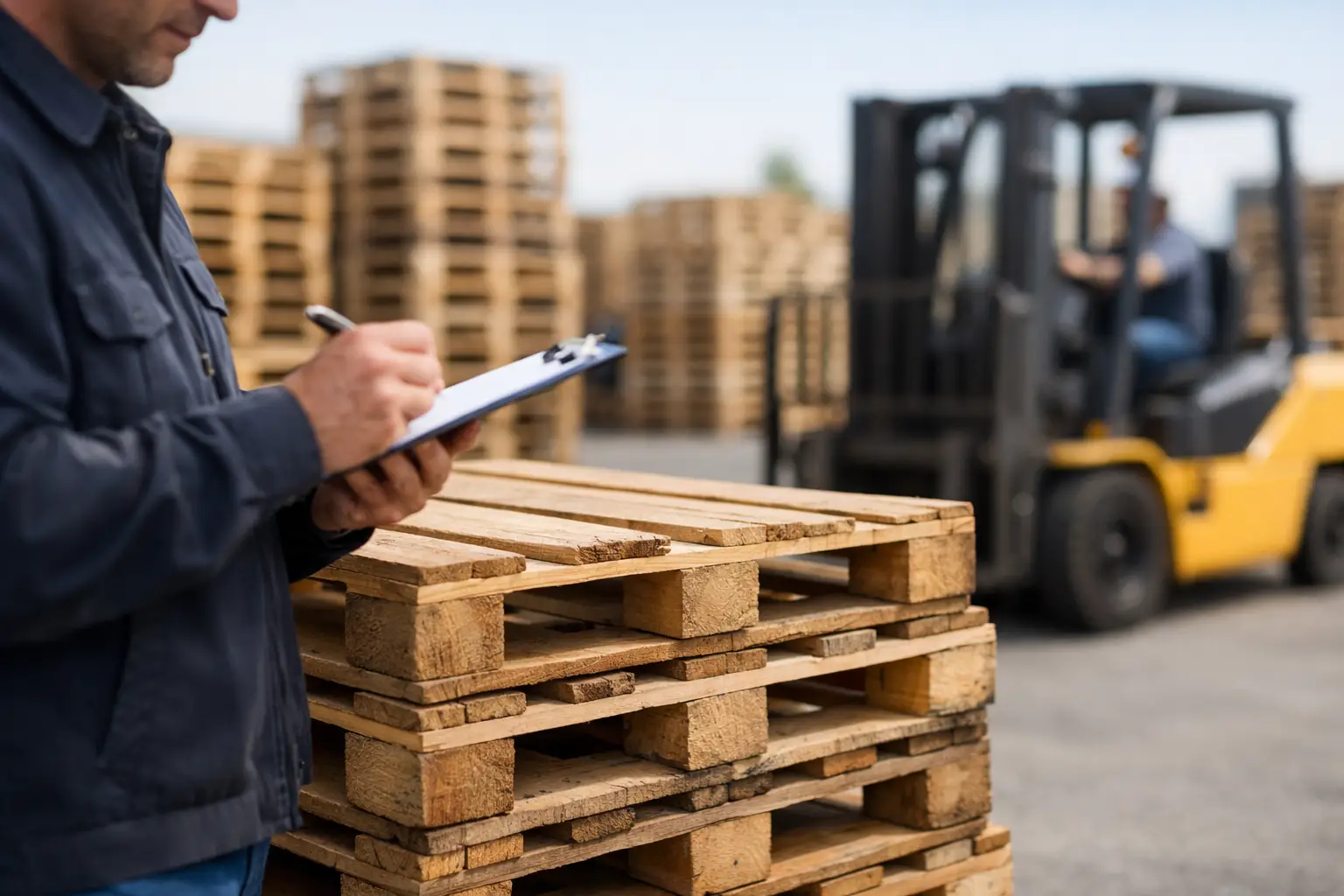
Pallet buy-back with G-PAL: you call +359 877 166 555, we come to you, inspect the pallets, pay on the spot and load them up. We buy EPAL and UIC euro pallets, skids and other wooden pallets, whether new, used or broken, with no sorting needed. The price is the price for the day.
Updated: 12 October 2026 · G-PAL (Dzhipal Ltd), Plovdiv
When pallets that are no longer part of day-to-day circulation pile up in the warehouse, they start taking up space, getting in the way of operations and tying up resources that could be put back into the business. This pallet buy-back guide is aimed at companies that want a clear, practical process – with no wasted time, no vague terms and no compromise on fair dealing.
When it comes to buy-back, the key question is not just whether the pallets can be sold, but on what terms it makes sense to do so. For logistics hubs, manufacturers, retail outlets and construction firms, this is rarely a one-off decision. In many cases there is a steady flow of standard or non-standard pallets that need to be valued, sorted and cleared on time.
How pallet buy-back works in practice
A good process starts with clarity from the outset. The usual details to confirm are the type of pallets, the quantity, their condition, the location and whether loading is possible. It sounds basic, but this is exactly where time is often lost. If a company sends only rough information and it then turns out on site that there are mixed sizes, breakages or heavily worn units, both the price and the arrangements change.
In a model that works, a preliminary valuation is made first. Then it is agreed whether the pallets will be handed over on site or whether transport will be arranged. For companies with larger stocks this is crucial, because logistics has a direct impact on the final value of the deal.
In practice, euro pallets and other standard formats remain the most sought after, as they can be put back into use after inspection, sorting or repair. Non-standard pallets can also be bought back, but their valuation is more case-by-case. What matters there is not only the dimensions, but also whether there is a genuine market for reusing them.
Pallet buy-back guide by pallet type
Not every pallet is valued in the same way. The difference between EPAL, UIC, ordinary wooden pallets and non-standard solutions is significant. If you run a warehouse or handle procurement, it is worth taking this into account before you even make an enquiry.
Euro pallets and licensed pallets
Euro pallets are usually the easiest to sell, because they are standardised and widely used in transport, warehousing and export. The things we look at are size, markings, structural integrity and degree of wear. A pallet with missing boards, serious breakages or damaged blocks will not be valued as a pallet in good commercial condition, even if it is the right type.
With certified pallets there is one more factor – whether the markings are legible and whether the unit meets the requirements for reuse. This matters to companies that work in export and care about traceability and standards.
Used wooden pallets
The range here is wider. Some used pallets are perfectly fit for another working cycle, while others are worth more as material or as a base for repairs. The price depends on their actual condition, not simply on the fact that they are wooden and look standard.
If the pallets are dry, sound, free from critical deformation and can be stacked safely, the chances of a good valuation are considerably higher. If they have been left outdoors for a long time, are heavily soiled or show traces of aggressive loads, this almost always pushes the value down.
Non-standard pallets and skids
There is no universal price for non-standard sizes. What we look at is whether the pallet can be reused in a particular sector, how many units there are and whether the size is in demand. A small batch of unusual pallets is often harder to move on than a large quantity of standard euro pallets.
That does not mean non-standard pallets are not worth it. If the size suits a particular manufacturing or commercial operation, buy-back can be entirely worthwhile. The valuation is simply more specific and depends on the market at the time.
What affects the price
The price is not set from a photo alone, nor does it come down to a single flat rate. Four factors have the strongest influence – the type of pallet, its condition, the quantity and the logistics.
Condition is decisive, because it determines whether a pallet goes straight back into use, needs repairing or is valued considerably lower. Quantity also carries weight. Single units or very small batches are often less convenient to organise, whereas with larger volumes the process is more efficient and the terms can be better.
Location is not a minor detail either. If the pallets are somewhere convenient for loading, with access for transport and a clear handover arrangement, this saves time and costs. For companies in Plovdiv and the surrounding region, this kind of operational proximity often makes a real difference, as it allows a faster response and easier collection planning.
There are also cases where the highest price per unit is not the best option. If the buyer is unreliable, delays the inspection, changes the terms on site or lacks the capacity to collect on time, the real cost to the business ends up higher. Lost time in a warehouse environment costs money.
How to prepare your pallets for an accurate valuation
If you want a quick and realistic offer, prepare the information the way you would want to receive it from a supplier yourself. Quantities should be roughly counted, the types separated and any clearly unusable pallets flagged in advance. Where batches are mixed, it is best to say so right at the start.
Photos help, but only if they are informative. A single general shot from a distance is not enough. It is more useful if the stacking, condition and differences between types can be seen. If a batch contains standard euro pallets, non-standard pallets and wooden skids, this should be made clear.
It is also good practice to state whether loading on site is needed and what truck access is like. This is part of the valuation, not an extra detail. For companies with a constant rotation of pallets, it makes sense to think not only about the current buy-back but also about a long-term collection schedule.
When buy-back is the right decision – and when it is not
Not all stock needs to be sold straight away. If you have a stable internal turnover and the pallets will be reused shortly, it is sometimes wiser to keep them. This applies above all to standard pallets in good condition that you will need again anyway.
On the other hand, if pallets sit idle for months, build up seasonally or get in the way of warehouse operations, buy-back is a practical solution. It frees up space, reduces clutter and puts value back into circulation. For many companies this is more useful than passively storing an asset that is not working.
There is also a middle ground – selling part of the stock and keeping the rest. This is often a good solution for mixed batches, where some pallets are suitable for internal use and others are simply surplus.
What to expect from a reliable partner
A reliable buy-back partner does not rely on vague arrangements. They ask the right questions at the start, give a realistic valuation and stick to what was agreed at inspection and loading. This is especially important for companies that work to a schedule and cannot afford last-minute disruption to their operations.
It also matters whether the supplier or buyer knows the different categories of pallets, including certified solutions, non-standard sizes and options for subsequent reuse. When the other side has genuine hands-on experience, the process runs faster and with fewer corrections.
GPAL is an example of a partner that combines buy-back, sales and logistics in a single working service. For businesses, this means clearer communication, faster organisation and fewer unnecessary steps, especially when it comes to regular quantities and an operational need for a quick response.
Common mistakes when selling pallets
The most common mistake is asking for a price without giving enough information. The second is assuming that every used pallet has the same value. The third is waiting too long, until the stock becomes awkward to handle and some of the pallets deteriorate further.
Just as often, companies underestimate the value of a regular process. If similar quantities build up every month, it is better to set up a clear handover arrangement rather than reacting only when the warehouse is overflowing. That way, both the valuation and the organisation are usually better.
Pallet buy-back is not simply clearing out the yard or warehouse. It is part of managing the flow of materials, and when it is done on time and with the right partner, it brings order, free space and predictability. If you value a quick response, clear terms and a fair price based on condition and quantity, the best move is to act before your pallets turn from an asset into a problem.
More on buy-back
See euro pallet buy-back in 5 steps, what the buy-back price depends on, sell your pallets and buy-back by city. Sound pallets we buy back are returned to circulation through the G-PAL pallet exchange.
How the buy-back works
- Assessment. Tell us the type, number and address on +359 877 166 555 or via Viber/WhatsApp. We inspect the pallets on site and give you the price for the day.
- Payment on the spot. We pay immediately, at loading.
- Free transport from 50 pallets. For 50 or more pallets we come with our own truck at no transport charge.
For fewer pallets, give us a call – we will arrange the trip.
Frequently asked questions
Who buys wooden pallets in Plovdiv?
G-PAL (Dzhipal Ltd) buys pallets and skids at its warehouse at 270 Vasil Levski Blvd in Plovdiv and comes to you with its own truck.
What pallets do you buy?
All types: EPAL and UIC euro pallets, euro skids, industrial and non-standard pallets, including worn and broken ones.
How much do you pay per pallet?
The price is the price for the day and depends on the type, condition and quantity. We will give it to you on +359 877 166 555.
When do you pay?
Immediately, on the spot, after inspection.
How many pallets do you need for free transport?
Transport is free from 50 pallets upwards – we come with our own truck and pay on the spot. For fewer pallets, call +359 877 166 555 and we will arrange the trip.
Do you pay straight away?
Yes. We pay on the spot, right after the inspection and loading.
📞 Call: +359 877 166 555 · Viber · WhatsApp
How the service works and which pallets we pay for: pallet and skid buy-back. For your city, see also buy-back by city.
Updated: 09.11.2026
About the author
depal
Pavel Damyanov is the manager of DZHIPAL Ltd (G-PAL) - a manufacturer and supplier of euro pallets, wooden skids and pallet collars based in Plovdiv, 270 Vasil Levski Blvd. The company is a licensed EPAL pallet repair operator (licence No. BG-308), buys back pallets and skids on site and delivers nationwide with its own transport.
Published on 25 May 2026, updated on 20 November 2026
Need today's price? Tell us the pallet type, quantity and city and we will reply with today's price.
Request a price
