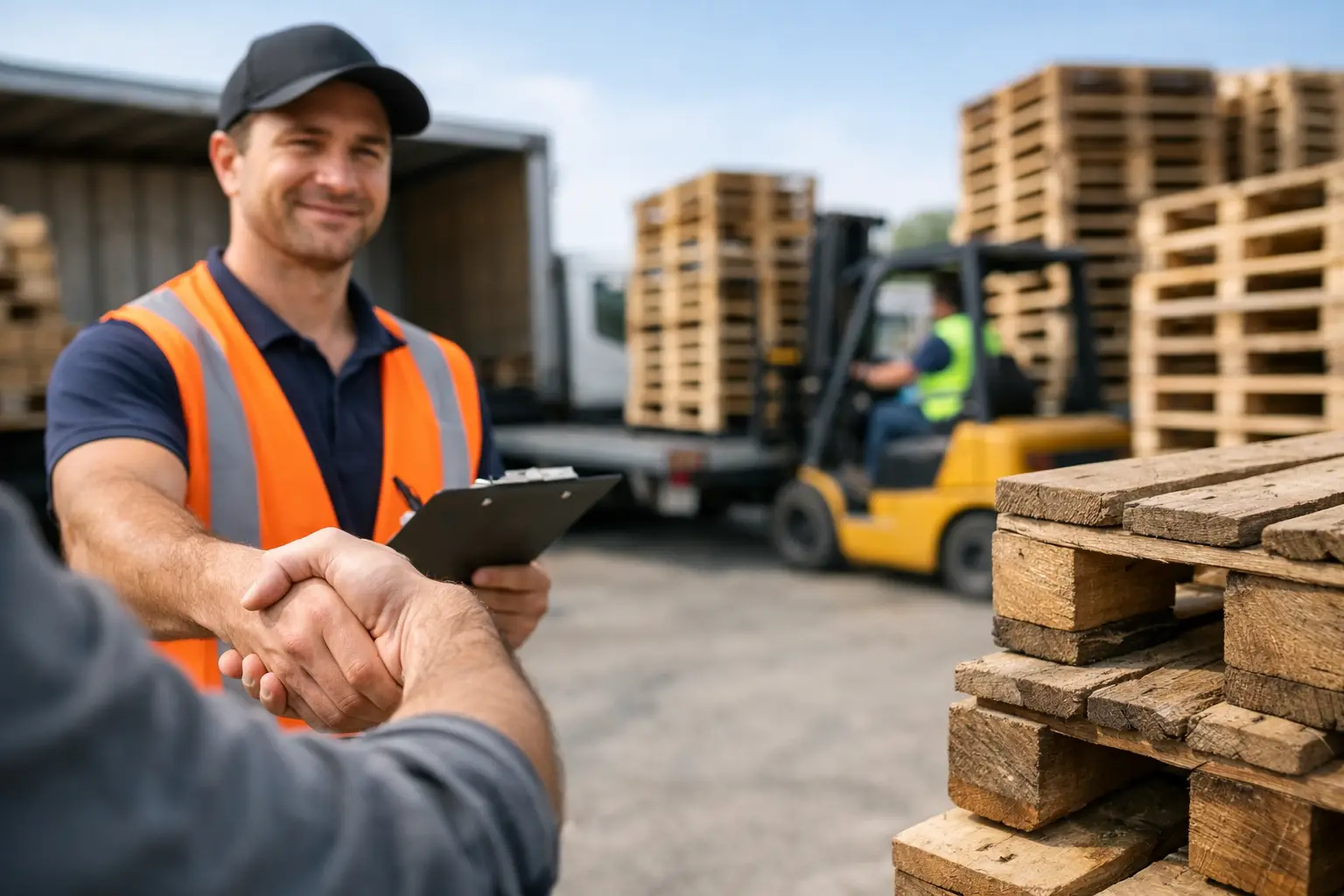
When spare pallets start piling up in the warehouse, it is rarely a minor operational issue. Floor space is taken up, movement is obstructed, resources sit idle and material stays put without adding any value. That is exactly why a pallet buy-back service in Plovdiv is a practical solution for companies that want to free up space quickly and turn the pallets they have into real turnover.
For haulage companies, production sites, retail outlets and warehouses, the key is not simply to “hand over” the pallets. What matters is that the process is clear, the price is fair and the collection does not create extra organisational work. When you work with a partner who knows the market, the valuation is quicker and the logistics do not turn into a new problem.
When pallet buy-back in Plovdiv is the right move
Selling pallets usually comes about in one of three situations. The first is a build-up of used pallets from regular deliveries and dispatches. The second is the restructuring of a warehouse or production area, which leaves some of the existing pallets surplus to requirements. The third is replacing the pallet pool with a more specific standard – for example, switching to EPAL, UIC or a non-standard size to meet customer requirements.
In these cases, waiting rarely helps. The longer pallets sit outdoors, unstacked and unprotected, the more their condition deteriorates. This has a direct impact on the price. If the material is well kept, dry and sorted, the chances of a better valuation are higher.
There is one more practical point. For many companies, buy-back is not a one-off deal but a recurring process. If you generate a certain quantity of pallets every week or every month, it makes sense to think about a regular outlet rather than looking for a buyer on an ad hoc basis.
Which pallets are usually bought back
Not every pallet has the same market value. That depends on the standard, condition, repairs, size and whether the pallet can be reused in a real logistics environment. Euro pallets and other standardised wooden pallets remain the most sought after, because they have predictable uses and are easier to resell.
We buy back used EPAL and UIC pallets, as well as other wooden skids and load carriers, provided they are in a condition that allows reuse, repair or reprocessing. Non-standard sizes can also have value, but here the valuation depends more on current demand. If the size is specific and suitable only for a limited type of load, the price is usually set more cautiously.
Overall condition also matters a great deal. Pallets with broken boards, damaged blocks, moisture, mould or heavy soiling are usually valued lower. On the other hand, well-kept pallets with minimal signs of use retain good commercial potential.
What affects the price most
Quantity is important, but it is not the only factor. With pallet buy-back in Plovdiv, the main things assessed are the standard, the degree of wear, any breakages, whether the pallets can be reused quickly and whether they need repair. Location and access for loading also play a part, especially with larger quantities.
Companies sometimes expect a single price for all their pallets, but that is not always realistic. Mixed batches of different sizes and grades are rarely valued in a uniform way. That is why information provided in advance is important – it saves time for both sides.
How pallet buy-back in Plovdiv works
A good process is short and predictable. It usually starts with sending details of the type of pallets, an approximate quantity, their condition and the address for inspection or loading. If you have photos, the valuation can be faster and more accurate right from the start.
Next comes confirmation of what can actually be bought back and on what terms. For smaller quantities, direct drop-off can be arranged, while for larger ones transport can be organised. This is particularly important for companies that do not want to commit their own truck, staff and time to moving the pallets out.
When the pallets are prepared and access is ensured, the loading itself goes much more smoothly. If the site works to a schedule, it is a good idea to align the collection window with the warehouse’s actual workload. That way, incoming deliveries and dispatches are not disrupted.
For the business, the value is simple – less disruption to operations and space freed up faster. With regular quantities, this model can become an ongoing service rather than a separate administrative task every time.
How to prepare pallets for a faster and more accurate valuation
The most practical approach is to separate them by type and condition. Standardised pallets in one group, non-standard ones in another, and heavily damaged ones in a group of their own. This helps keep the valuation realistic, without unnecessary adjustments on site.
It is also worth checking whether the batch is dry and whether the pallets have been left for a long time in mud, rain or a harsh environment. In many cases, storage is precisely what makes the difference between a pallet that can be resold well and one that ends up with a low valuation.
If you have an exact count, say so. If not, give a realistic range. For a company planning transport and loading, the difference between 80 and 180 pallets is no small detail. The same goes for access – loading dock, forklift, manual loading, yard, covered warehouse. These details are not a formality but part of the final offer.
Why a regional partner is often the better choice
With pallets, logistics matter almost as much as price. If the buyer is far away, transport costs and organisation time quickly change the numbers. That is why, for many companies, buy-back locally is more efficient than searching a wider market with uncertain results.
A partner that is active in the region usually responds faster, knows the types of customers involved and can handle both one-off deals and regular flows. This is especially useful for companies with day-to-day warehouse activity, where free space and the quick movement of load carriers have a direct impact on operations.
This is where the difference between a casual buyer and a genuine provider of a complete solution becomes clear. When one company combines buy-back, sales, stock, transport and a sound knowledge of the standards, the process becomes more predictable. For the business, that means fewer arrangements to make and less risk of wasted time.
When a low price is not necessarily a bad offer
Companies sometimes compare only the amount per pallet and overlook the other terms. If someone offers a slightly higher unit price but has no clear transport arrangements, delays collection or rejects part of the quantity on site, the overall result may turn out to be weaker.
Conversely, a fair offer with fast service, an accurate preliminary valuation and genuine collection is often the better business decision. This is especially true when it comes to freeing up warehouse space, closing down a site or regularly clearing accumulated pallets. In such cases, speed and reliability have a very tangible value.
The type of pallets you are selling also matters. If the batch is mixed and some of it needs repair, it is not realistic to expect the same price as for well-kept EPAL pallets in circulation-ready condition. A fair valuation does not over-promise; it is based on actual quality.
What companies look for when choosing a buyer
For B2B customers, three things matter most – clarity, quick response and predictability. No warehouse manager wants lengthy back-and-forth over something that can be resolved operationally. That is why a good partner asks the right questions at the outset and gives a concrete answer, rather than leaving the deal in “we’ll see” mode.
Just as important is the ability to work with both small and large volumes. Today you may have 30 pallets, in a month’s time 300. If your partner is ready to handle both, you create a model that works, rather than looking for a solution from scratch every time.
For companies that want to optimise the entire cycle, it is good practice to work with a supplier that not only buys back pallets but also offers new and used pallets, non-standard solutions, timber and transport. This allows more flexible stock management. When needed you sell, when needed you restock, without changing partner for every different task.
GPAL works with exactly this practical focus – quick response, clear terms and solutions that suit the real work of warehousing, production and transport.
If you have pallets that are just taking up space, the best time to have them valued is before they start losing value. A timely sale frees up space, improves organisation and returns resources to the business.
How the buy-back works
- Assessment. Tell us the type, number and address on +359 877 166 555 or via Viber/WhatsApp. We inspect the pallets on site and give you the price for the day.
- Payment on the spot. We pay immediately, at loading.
- Free transport from 50 pallets. For 50 or more pallets we come with our own truck at no transport charge.
For fewer pallets, give us a call – we will arrange the trip.
Questions about the buy-back
Do you pay straight away?
Yes. We pay on the spot, right after the inspection and loading.
How many pallets do you need for free transport?
Transport is free from 50 pallets upwards – we come with our own truck and pay on the spot. For fewer pallets, call +359 877 166 555 and we will arrange the trip.
About the author
depal
Pavel Damyanov is the manager of DZHIPAL Ltd (G-PAL) - a manufacturer and supplier of euro pallets, wooden skids and pallet collars based in Plovdiv, 270 Vasil Levski Blvd. The company is a licensed EPAL pallet repair operator (licence No. BG-308), buys back pallets and skids on site and delivers nationwide with its own transport.
Published on 21 May 2026, updated on 20 November 2026
Need today's price? Tell us the pallet type, quantity and city and we will reply with today's price.
Request a price
