New EPAL pallets from €16.20, used light-grade EPAL from €11.00 – order on +359 877 166 555 or via Viber/WhatsApp.
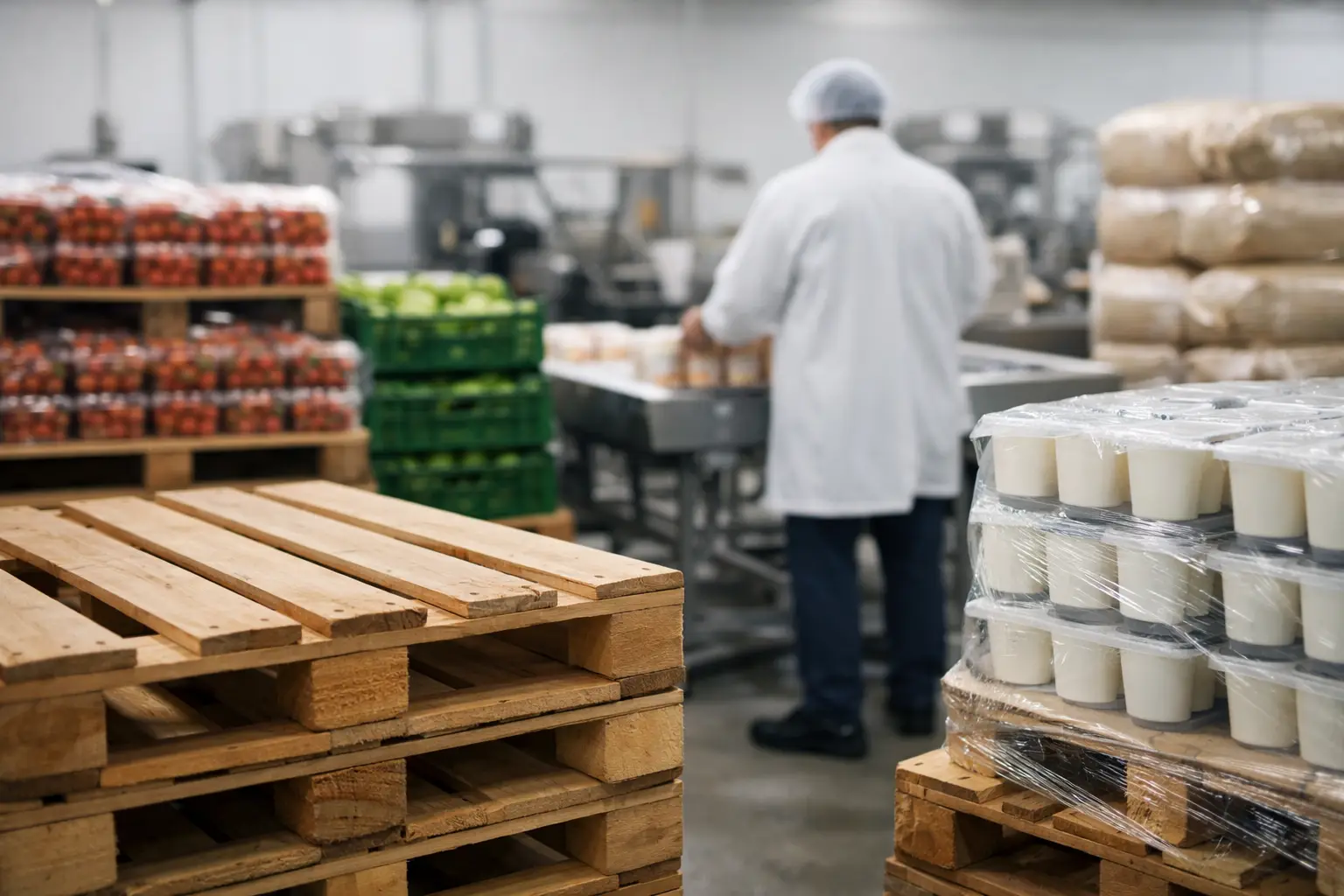
When a pallet comes into contact with food packaging, there is no room for compromise. What looks like a routine delivery can pose a real risk if the load carrier has broken boards, moisture, contamination or the wrong treatment. That is why pallets for the food industry should not be chosen on size and price alone, but on whether they meet the real requirements of production, warehousing and transport.
In the food sector, one-size-fits-all solutions are rare. Stacking packaged dry goods in a central warehouse is one thing; handling beverages, dairy products, frozen goods or exports to different markets is quite another. The right pallet has to bear the load, support good hygiene, move smoothly through the warehouse system and avoid causing unnecessary losses along the supply chain.
What sets food industry pallets apart
With this type of pallet, cleanliness, consistent condition and stability in handling matter most. In many production facilities the pallet does not touch the food directly, but rather cartons, crates, film or secondary packaging. That does not remove the need for it to be in good technical condition. Cracked components, protruding nails and signs of moisture are a problem not only for safety, but for the entire warehouse process.
For this reason, food businesses usually look for pallets of clear origin, uniform dimensions and consistent quality with every delivery. Inconsistent quality hampers automation, makes internal handling more expensive and increases wastage. In practice, a cheap pallet often ends up costing more if it leads to damaged packaging, complaints or stoppages in loading and unloading.
The environment in which the pallet will be used also matters. Requirements in a dry warehouse are one thing; in chilled areas with higher humidity they are another. Where floors are washed intensively, goods are turned over frequently and rotation is high, the construction and condition of the pallet become even more important.
Wooden or plastic pallets for the food industry
The most common question is whether to use wooden or plastic pallets. The answer depends on the product, the logistics environment and the budget.
Wooden pallets remain a widely used option because they are economical, easy to replace, available in standard sizes and suitable for a range of load conditions. For many companies they are a perfectly workable choice, provided the pallets are sound, dry, well maintained and suited to the specific application. For exports and international transport, the timber often has to be treated to ISPM 15 (Standard 15), which also needs to be planned for in good time.
Plastic pallets have the edge where a higher level of hygiene, easier washing and more consistent performance on automated lines are required. They suit environments with strict sanitary requirements, but their upfront cost is higher. In addition, under certain loads and with improper use, some models can deform, or may not make economic sense in open logistics loops where pallets often do not come back.
For many food producers and distributors, the best solution is not to choose one material for everything, but to split by process. For example, plastic pallets in internal production areas and quality wooden pallets for storage, transport and dispatch. This cuts costs without sacrificing control.
When new pallets are the better choice
For food products, new pallets often provide the greatest peace of mind. They offer uniform construction, predictable load capacity and a better appearance when dispatching to retail chains, distribution centres and overseas markets. If a company operates with strict traceability requirements and internal checks, a new pallet makes control easier.
This is especially true for sensitive products, high turnover and situations where the pallet is part of how the goods are presented to the customer. In these cases, saving money on a cheaper but inconsistent load carrier is rarely sensible.
Of course, not every process requires new pallets. For secondary warehouse operations, internal handling or less sensitive packaging, used pallets of verified quality can also be a good solution. The condition is that they are properly selected – free from structural defects, without heavy contamination and to a clear standard of condition.
The importance of standard, size and load capacity
The sector most commonly uses 1200 x 800 mm euro pallets, because they are compatible with most warehouse equipment, vehicles and racking systems. But that does not mean the standard size is always the best.
If you work with non-standard cartons, light but bulky products or specific production lines, the pallet size should be matched to the actual load. Overhanging goods, uneven weight distribution and excessive stretch-wrapping create instability and increase the risk in transit. A well-chosen pallet reduces these problems from the outset.
Load capacity should not be taken from a catalogue without context either. There is a difference between static loading, dynamic handling with a forklift and storage in racking. A pallet that is adequate for floor storage may not be suitable for high racking levels or for heavy beverages, tinned goods and raw materials. So when ordering, it is important to specify not just the kilograms per pallet, but exactly how it will be used.
Hygiene, traceability and control on delivery
In the food sector, the pallet is part of the controlled environment, even when it does not come into direct contact with the product. Good practice therefore starts as soon as the delivery is received. If pallets arrive damp, visibly dirty or with mixed quality within a single batch, that is a warning sign of difficulties to come.
It is worthwhile for every company to have a clear goods-in inspection. The process need not be onerous, but it must be consistent. Check the main dimensions, strength, absence of breakages, condition of the boards and treatment where required. For exports or specific customer requirements, the paperwork is just as important as the physical condition.
This is where a reliable supplier saves time. When you receive a consistent standard, there is no need for every delivery to go through lengthy sorting and removal of unusable pallets. For companies dispatching daily, this has a direct effect on speed and costs.
Food industry pallets and international transport
For exports, the pallet is not just a carrier but part of the delivery requirements. Wooden pallets for the food industry often need to be heat-treated and marked in accordance with Standard 15. If this is overlooked, the risk is not only delays, but also rejection of the consignment or additional costs at the border.
Especially when serving several markets, it is unwise to leave treatment until the last minute. Companies that plan ahead avoid pressure on dispatch and keep a more predictable schedule. This matters for seasonal goods, short delivery lead times and agreed delivery windows.
In this kind of environment, a partner with stock, its own transport and clear control over standards is a real advantage. GPAL works precisely along these lines – supplying the right pallet at the right time, without unnecessarily complicating the process.
How to choose a supplier, not just a pallet
A good offer is not just the price per unit. For the food industry, what matters more is whether you can count on consistency, quick response and clearly agreed quality. If you receive one standard today and another next week, it causes problems in the warehouse, with the customer and in your records.
Look for a supplier that can handle both regular and urgent orders. It matters whether they have stock, whether they offer new and used options, whether they can produce non-standard sizes and whether they understand the difference between a pallet for internal circulation and one for export or a retail chain.
It is also useful to have the option of pallet buy-back, replacement and logistics tailored to your volume of work. This makes costs more predictable and simplifies procurement. In practice, the best supplier is the one that means you do not have to think about pallets every day, because the process simply works.
When choosing pallets for the food industry, treat them as part of the quality of your delivery rather than a secondary consumable. The right choice protects the product, speeds up logistics and spares you problems that usually prove most costly precisely when the schedule is tightest.
Frequently asked questions
How much do pallets for food cost?
New EPAL from €16.20, used EPAL light grade from €11.00, medium grade from €10.00, dark grade from €7.00, euro skid 120×80 from €4.20. Today’s exact price depends on grade and quantity – we will tell you straight away on +359 877 166 555.
See also: choosing pallets for food, new euro pallets, pallet prices today.
Updated: 11 November 2026
About the author
depal
Pavel Damyanov is the manager of DZHIPAL Ltd (G-PAL) - a manufacturer and supplier of euro pallets, wooden skids and pallet collars based in Plovdiv, 270 Vasil Levski Blvd. The company is a licensed EPAL pallet repair operator (licence No. BG-308), buys back pallets and skids on site and delivers nationwide with its own transport.
Published on 22 June 2026
Need today's price? Tell us the pallet type, quantity and city and we will reply with today's price.
Request a price
