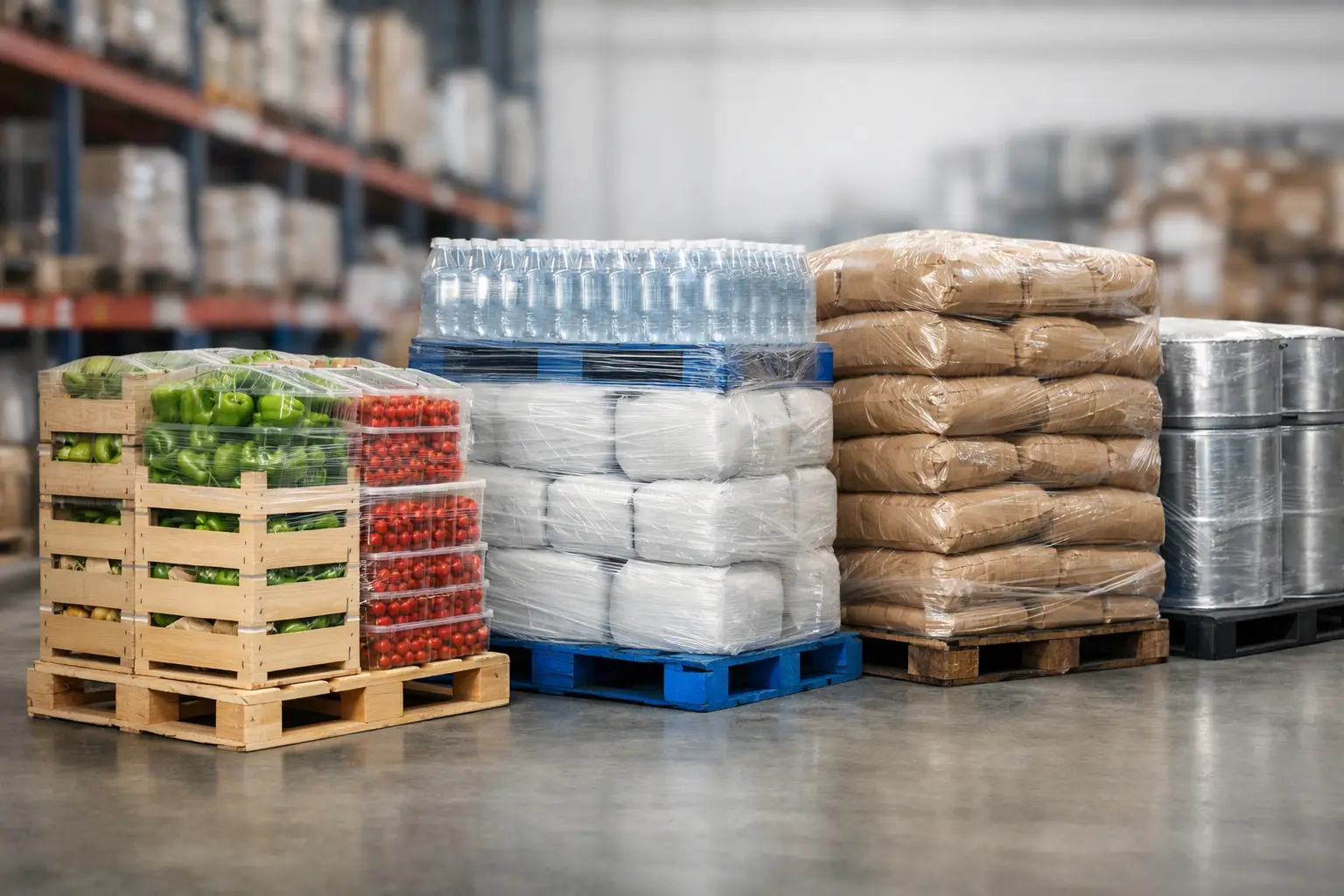
For food, use dry, clean pallets with no mould, stains or foreign odours – new EPAL or light-grade used EPAL pallets are the safest choice. The ISPM 15 (Standard 15) mark proves heat treatment for export, but it is not a food-contact certificate. G-PAL sells new and light-grade used euro pallets from its warehouse in Plovdiv.
Updated: 12 October 2026 · G-PAL (Dzhipal Ltd), Plovdiv
The pallet often gets little attention – until a dirty, damp or damaged base delays a shipment, compromises packaging or leads to a customer rejecting a delivery. When choosing pallets for food, comparing size and price is not enough. You need to consider the product, how it is packed, the storage conditions it will pass through and the requirements set by the recipient.
For food warehouses, manufacturers, distributors and traders, the right pallet is an operational decision. It affects the safety of the goods, loading speed, use of warehouse space and the cost of complaints. Good practice starts with a clear separation between pallets used for external logistics and pallets that may end up close to unprotected food products.
Choosing pallets for food starts with the type of packaging
The key question is whether the food has secure primary packaging. For sealed cartons, stretch-wrapped stacks, bottles, tins and other well-protected products, wooden pallets are a practical and widely used solution. They offer good load capacity, easy forklift handling and compatibility with mainstream transport systems.
When the product is unprotected, open or could come into direct contact with the pallet, the requirements are different. In such cases, specialised solutions are usually sought in line with the manufacturer’s internal food safety system – for example plastic pallets, pallets with a suitable protective surface or other carriers approved for the specific production area. A wooden pallet should not automatically be assumed suitable for direct contact with food.
This distinction prevents mistakes. A pallet for transporting cartons of dry food may be an excellent choice for an external warehouse yet not be permitted in a clean production zone. The decision depends on a risk assessment, not just on the type of load.
Hygiene matters more than appearance
With food, do not choose pallets simply because they look sturdy. Inspection should look for specific signs of risk: traces of moisture, mould, unpleasant odours, spills, grease stains, heavy soiling, residue from previous loads and disintegrating boards. Even a pallet with good load capacity may be unsuitable for food logistics if its hygiene is questionable.
Used pallets call for particular attention. They are a sensible option for many sealed, well-packed goods, provided they are properly sorted, dry and structurally sound. Their advantage is the lower price. The trade-off is that you need reliable quality control on delivery and when accepting them into your warehouse.
For sensitive products, customers with demanding audit requirements or new production lines, new pallets offer greater predictability. They have no history of previous loads and make it easier to enforce a single standard across the warehouse. This does not mean they are always mandatory. It means that where the risk is higher, the price difference is often justified.
A dry pallet protects both the load and the packaging
Moisture is one of the most common causes of problems. Wet timber can transfer moisture to cardboard packaging, weaken the boards and create conditions for mould. If pallets are stored outdoors or delivered in bad weather, provide a dry area for receiving and inspection before they enter the warehouse.
Do not stack pallets directly on a wet floor or leave them pressed against walls with condensation. Good ventilation and a clean storage area are not minor details. They are part of protecting the packaging and maintaining an effective hygiene regime.
Pallet material, size and construction
The standard 1200 x 800 mm euro pallet is preferred across many food supply chains because it works with widely used racking, forklifts, vehicles and automated systems. It is a convenient choice when the recipient requires the EPAL format or when goods move through several warehouses and distribution centres.
But the standard size is not a universal answer. Lighter but bulky products may need a different format. For sacks, crates, beverages or tall palletised loads, the construction must also be assessed – the number and layout of the boards, the condition of the blocks, the number of nails and the stability of the base.
Load capacity is not just a figure from a general specification. Load distribution, stack height, lifting method and whether the load will sit in racking all matter. A pallet that performs well under an evenly distributed load on the floor may behave differently under a point load or when used at height. If the load is heavy, unstable or of a non-standard size, ask for a solution based on actual use rather than assumptions.
Pallet collars for safer transport
For sacks, bottles, jars, taller cartons and loads at risk of shifting, pallet collars can improve stability. They do not replace proper stretch wrapping, but they help form a reliable unit load. This is also useful for frequent internal movement between the warehouse, production and dispatch.
Before introducing them, check that their height is compatible with your racking, loading bay and vehicle. The practical solution is the one that protects the goods without creating new delays during loading.
A treatment certificate is not a food certificate
For exports outside the European Union, wooden packaging material is often required to be treated and marked under International Standard for Phytosanitary Measures No. 15, known as ISPM 15 (Standard 15). This mark proves that the timber has undergone the necessary phytosanitary treatment to limit the risk of spreading pests.
However, it is not proof that the pallet is suitable for direct contact with food, nor does it automatically cover every requirement of a food audit. These are separate matters. For food safety, what counts is cleanliness, condition, traceability, warehouse procedures and the rules applicable to the specific customer.
For exports, do not wait until loading day. When placing your order, specify the destination country, type of load, pallet format and any marking required. That way the supplier can offer the right solution and your team will not have to swap pallets at the last minute.
How to introduce clear checks on receipt
Even the best supplier does not remove the need for an internal procedure. Warehouse staff should know which pallets are accepted for food products and which are set aside for other uses. A quick check on unloading is enough, provided it is consistent: look at dryness, cleanliness, odour, broken components, protruding nails and visible signs of contamination.
It is helpful to store pallets for food products in a separate, clean area. Do not mix them with pallets that have carried chemicals, building materials, metal parts or unknown loads. Mixing makes checks difficult and increases the chance of an unsuitable pallet entering the wrong flow.
For businesses with steady turnover, it makes sense to agree on the exact type, quality grade, quantity and delivery schedule. GPAL works with new and used pallets, standard formats and solutions for specific needs, allowing companies to plan stock rather than hunt for pallets during an urgent shipment.
Price matters, but a disrupted flow costs more
The cheapest pallet is not always the most cost-effective. If weak construction damages cartons, if moisture compromises labels or if a customer rejects a delivery because of an unsuitable carrier, the real cost exceeds what was saved at purchase. On the other hand, not every product needs to travel on a top-grade new pallet.
The rational approach is to split your loads by risk. For standard, well-sealed goods, a good-quality used pallet may be sufficient. For sensitive products, exports, high-value loads or strict customer requirements, it is sensible to opt for a new, dry and clearly specified pallet. That way, the price reflects the real need.
The right choice does not start with the catalogue, but with the question of what will happen to the pallet after loading. Once you know the product, the packaging, the route and the recipient’s requirements, you can order exactly the right solution and keep your food logistics predictable every day.
Questions about pallets for food
Which pallets are suitable for food?
Dry, clean and sound pallets with no mould and no traces of chemicals. For packaged food, new or light-grade used EPAL pallets are most commonly used.
Light or dark grade used pallet for food?
Light grade. It is less worn and cleaner; dark-grade pallets are suitable for construction and internal warehouse use.
Is an ISPM 15 (Standard 15) certificate a food certificate?
No. It proves heat treatment against pests for export, not suitability for direct contact with food.
How much do pallets for food cost?
The price is for the day and depends on the type, grade and quantity. We will tell you straight away on +359 877 166 555.
See new EPAL euro pallet, used light-grade EPAL, pallet collars and delivery.
📞 Call: +359 877 166 555 · Viber · WhatsApp
Material comparison: plastic or wooden pallets – which is better value.
About the author
depal
Pavel Damyanov is the manager of DZHIPAL Ltd (G-PAL) - a manufacturer and supplier of euro pallets, wooden skids and pallet collars based in Plovdiv, 270 Vasil Levski Blvd. The company is a licensed EPAL pallet repair operator (licence No. BG-308), buys back pallets and skids on site and delivers nationwide with its own transport.
Published on 15 August 2026
Need today's price? Tell us the pallet type, quantity and city and we will reply with today's price.
Request a price
