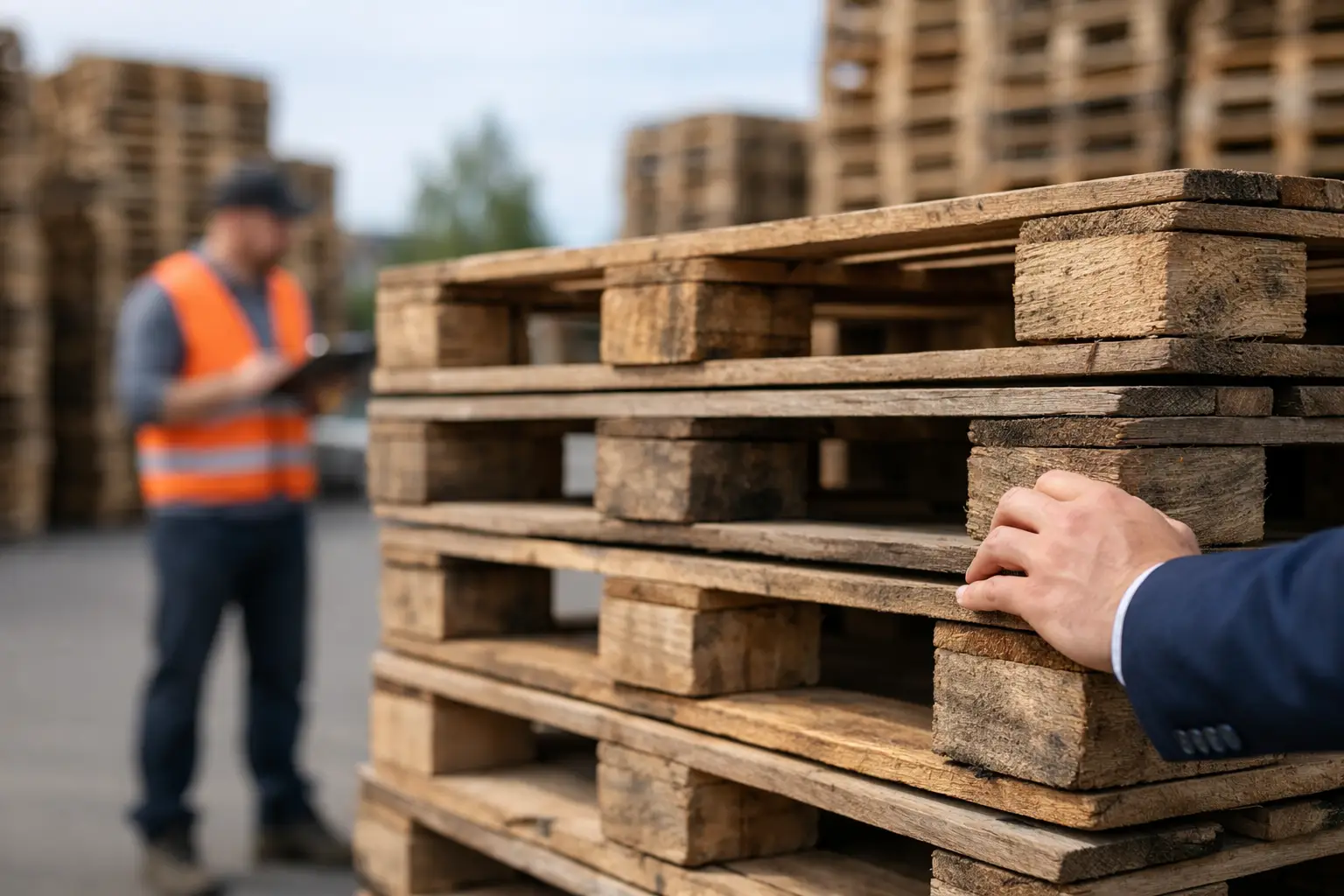
You can buy used pallets by the piece from the G-PAL warehouse in Plovdiv with no fixed minimum: light-grade EPAL (less worn) or dark-grade EPAL (cheaper). You can collect them yourself from 270 Vasil Levski Blvd, or we can deliver. The price is set for the day – call us for it on +359 877 166 555.
Updated: 12 October 2026 · G-PAL (Dzhipal Ltd), Plovdiv
When you need 20, 50 or 200 pallets at short notice, the answer is rarely “whatever’s available”. When buying used pallets by the piece, three things matter most: their actual condition, the exact size and the confidence that delivery won’t hold up your work. For a warehouse, production line, haulier or retail outlet, this isn’t a minor purchase – it’s part of day-to-day operations.
When buying used pallets by the piece is the right choice
This option is particularly practical when you don’t have a steady monthly volume or when your usage varies. Many businesses don’t want to tie up budget in large quantities if they have seasonal peaks, temporary sites or short logistics campaigns. Buying by the piece gives you flexibility and better control over costs.
There’s another common scenario: you need pallets for a specific shipment, for moving goods internally or for a temporary warehouse set-up. In cases like these, new pallets aren’t always economically justified. If the load doesn’t call for a flawless appearance, well-selected used pallets will do the job perfectly reliably.
Of course, not every situation is the same. For export, automated lines or more sensitive loads, the requirements are often stricter. There, the choice should be made after looking at the specific application, not on price alone.
What “a good-quality used pallet” actually means
In practice, this isn’t simply a pallet described as “second-hand”, but a load carrier that can keep working safely. A good used pallet has a sound structure, no critical breaks in the boards, no dangerous shifting of the blocks and no defects that create a risk during loading, unloading or stacking.
Signs of use are normal. Surface damage, darkened timber or marks from previous use are not automatically a problem. What matters is that there’s no compromise on load-bearing capacity and stability. If a pallet wobbles, has missing parts or visible poor-quality repairs, a low price can quickly turn out to be expensive.
With euro pallets and standard timber skids, it’s worth looking not just at the overall appearance but also at whether the dimensions are accurate. Even a slight deviation can cause difficulties with pallet trucks, forklifts or racking. This is especially true for businesses with a constant warehouse rhythm, where every small irregularity turns into lost time.
How to choose the right type for your work
The most common mistake is buying pallets purely on the lowest unit price. A better approach is to choose a pallet according to how it will be loaded, the environment and how often it will be used. For lighter loads and internal warehouse operations, a used pallet in good working condition may be entirely sufficient. For heavier goods or more intensive rotation, however, it’s worth looking for a higher grade of selection.
Size is not a formality
The standard size is convenient because it fits into mainstream logistics processes. But not every product is standard. If the load is oversized, the packaging is unusual or the space in the vehicle needs to be used to the full, the right pallet size has a direct impact on transport costs and warehouse organisation.
The condition must match the use
For one-off or short-term applications, it’s often enough for the pallet to be sound and functional. For repeated internal movement, it’s better to choose more thoroughly sorted stock. When pallets come into contact with customers, retail chains or stricter acceptance conditions, appearance matters too.
Not every load tolerates compromise
If you’re moving packaged building materials, the requirements are one thing. If you’re shipping higher-value goods, fragile packaging or products where stability is critical, the choice needs more care. Here, “it’ll do” usually leads to damage, complaints or internal losses.
What determines the price of used pallets by the piece
The price isn’t determined solely by whether the pallet is new or used. The type, standard, condition, quantity and current availability all play a part. When buying by the piece, the price is naturally different from that for large regular orders, but that doesn’t mean the terms can’t be favourable.
Condition is the main factor. Better-sorted, better-preserved pallets cost more, but the risk of rejects along the way is lower. If you take a cheaper batch with a high percentage of unusable pieces, the real price of each usable pallet goes up.
It also matters whether you’re looking for EPAL, UIC or another type of timber skid. Certified and standardised solutions usually sit within a clearer price range, whereas non-standard sizes depend heavily on availability. With urgent orders, the price can also be affected by logistics, especially if fast preparation and transport are required.
How to avoid poor deliveries
If you’re buying used pallets by the piece for the first time or switching supplier, look for clarity from the outset. It’s important to know exactly what pallet you’ll receive – size, type, approximate condition, the option of selection and delivery time. A vague description is usually a sign of future corrections, returned goods and wasted time.
Good practice is to specify what the pallets will be used for. This helps the supplier offer a solution that works, rather than simply whatever is in stock at the time. For serious businesses, this is standard procedure – first the application, then the quote.
If you have an ongoing need, it’s even more sensible to work with a partner who can provide consistency. The difference between a single good delivery and a stable supply is significant. In production and logistics in particular, predictability is often worth more than the lowest price on paper.
Why local availability matters
When time is short, being close to your supplier isn’t just a convenience. It saves time, transport costs and unnecessary complications. For businesses in Plovdiv and the surrounding region, this often means a faster response for urgent quantities, easier communication and the possibility of regular supply without long waits.
This is exactly where the model of a supplier that keeps stock, offers its own transport and handles both single and larger orders works well. GPAL is an example of this kind of partner – practical, operational and focused on the real needs of the business rather than on general promises.
When used pallets are not the best choice
There are cases where new pallets or strictly certified solutions are the better step. If you export to markets with specific requirements, if your customer only accepts a particular standard or if the pallets go into automated systems, the compromise isn’t worth it.
The same applies to high turnover. Sometimes a better-quality pallet with a higher initial price works out cheaper because it lasts longer and reduces rejects. This is a classic case where the choice isn’t between “cheap” and “expensive”, but between short-term and real cost.
How to place a good order
The most useful information for your supplier is specific information. Rather than simply asking for a price, state the pallet type, size, quantity, application and deadline. If you have requirements regarding load capacity, type of goods or condition, mention them from the very start. That way you get a quote that can actually be delivered.
For recurring needs, it makes sense to agree approximate quantities and a delivery schedule. This makes things easier for both sides. For the customer it means certainty, and for the supplier it means being able to keep the right stock and respond faster.
Buying used pallets by the piece is a sound move when you’re looking for a balance between price, functionality and lead time. There’s no need to pay for more than your work requires. What you need is pallets that do the job without surprises – exactly when you need them.
Frequently asked questions
Can I buy just a few pallets?
Yes, there’s no fixed minimum.
Light or dark grade pallet?
Light grade is less worn and more expensive; dark grade is cheaper and suitable for warehousing and construction.
Can I collect them myself?
Yes, from the warehouse in Plovdiv, Monday–Friday 08:00–18:00 and Saturday 09:00–14:00.
How much does a used pallet cost?
The price is set for the day and depends on the type, grade and quantity. Call us on +359 877 166 555 and we’ll tell you straight away.
See also: used pallets, light-grade EPAL, dark-grade EPAL, pallet bench.
📞 Call: +359 877 166 555 · Viber · WhatsApp
Selling old pallets? See euro pallet and skid buy-back.
About the author
depal
Pavel Damyanov is the manager of DZHIPAL Ltd (G-PAL) - a manufacturer and supplier of euro pallets, wooden skids and pallet collars based in Plovdiv, 270 Vasil Levski Blvd. The company is a licensed EPAL pallet repair operator (licence No. BG-308), buys back pallets and skids on site and delivers nationwide with its own transport.
Published on 28 April 2026
Need today's price? Tell us the pallet type, quantity and city and we will reply with today's price.
Request a price
