A new EPAL pallet starts from €16.20, a used EPAL from €7.00 – tell us the destination country and quantity on +359 877 166 555 or via Viber/WhatsApp and we’ll give you a price.
For exports outside the EU, you need wooden pallets treated and marked to ISPM 15 (Standard 15): the IPPC stamp, BG, the producer’s registration number and HT. The euro pallet 1200×800 mm is the most common choice; for containers and some markets, 1200×1000 mm. G-PAL delivers export pallets across Bulgaria – today’s price on +359 877 166 555.
Updated: 12 October 2026 · G-PAL (Dzhipal Ltd), Plovdiv
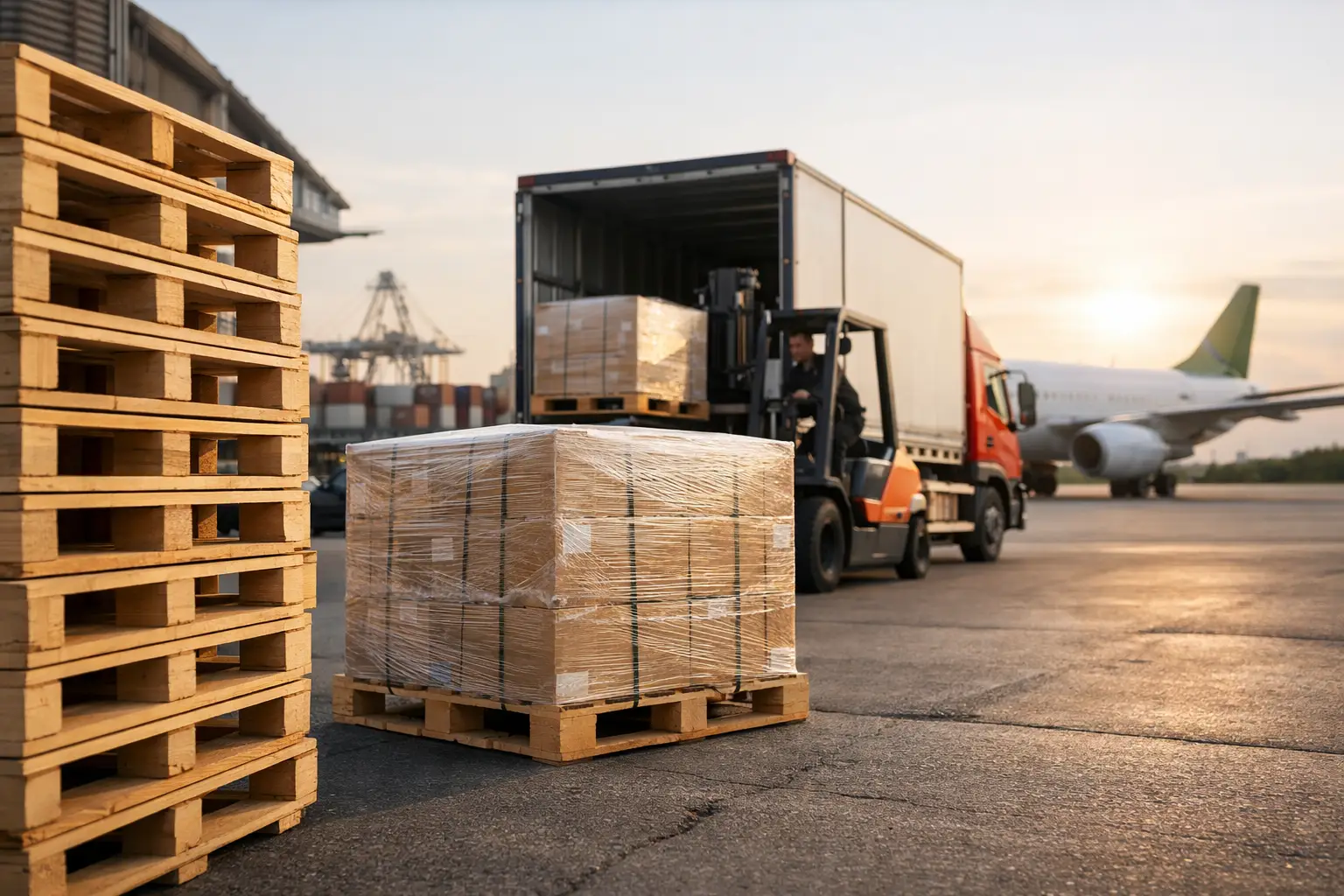
The goods are ready, transport is booked, and there is one question left in the warehouse that leaves no room for guesswork: what pallets do you need for export? The wrong choice can lead to a shipment being held at the border, a customer refusing delivery or goods being restacked at the last minute. In international transport, a pallet is not simply a base for the load. It is part of the packaging and must meet the requirements of the destination country, the carrier and the specific cargo.
For most companies, the decision starts with three things: the destination country, the pallet material and the actual load. A standard euro pallet is often the right choice, but on its own it does not guarantee suitability for export.
When ISPM 15 treatment is mandatory
When exporting outside the European Union, wooden pallets must in most cases be treated in accordance with the International Standard for Phytosanitary Measures ISPM 15, also known as Standard 15. Its purpose is to prevent pests from spreading through untreated wood.
The most widespread and widely accepted treatment is heat treatment – HT. The wood is heated until its core reaches the required temperature for a set period, which kills pests and larvae. After treatment, the pallet receives the mandatory marking. Pallets treated with methyl bromide are not a practical option for the European market, as this method is restricted and not used in standard production in the EU.
For goods moving between EU member states, ISPM 15 treatment is usually not required. That does not mean, however, that every shipment leaving Bulgaria is free of requirements. For the United Kingdom, Switzerland, Turkey, Serbia, North Macedonia, Middle Eastern countries, the USA, Canada, Australia and other markets, the rules for the specific destination should be checked.
Particular care is needed when exporting to Australia and New Zealand. Inspections there focus not only on correct treatment and marking but also on pallet cleanliness. Soil, plant residue, mould, insects or contamination can cause problems even when an HT stamp is present.
How to recognise an export pallet
An export pallet must carry a legible, durable IPPC mark. The marking is usually applied to the outer blocks or side elements and contains the IPPC symbol, the country code, the registration number of the producer or treatment facility and the treatment method code, for example HT.
Don’t assume that every pallet marked “EPAL” or “EUR” is automatically fit for export. The EPAL marking shows that the pallet has been made to a defined standard for dimensions and construction. It does not replace the phytosanitary stamp. For exports outside the EU, look for both sound construction and a valid, clear ISPM 15 marking.
With used pallets, checking is even more important. The stamp must be visible, and the pallet must not have been repaired with non-original components, nor have broken boards or heavily soiled blocks. If the marking has been obscured by paint, moisture, repairs or wear, customs or phytosanitary inspectors may not accept it.
What correct marking means
A correct mark is not a sticker, and it is not applied by hand to any random pallet. It is part of a certified production or treatment process. Any unclear, incomplete or questionable marking puts the entire shipment at risk.
Do not paint over the area with the stamp or cover it with film, labels or strapping. When dispatched, pallets should remain identifiable and accessible for inspection from all sides wherever possible.
Which pallet size to choose
The size is chosen according to the goods, the recipient’s warehouse, the vehicle and the unloading method. In Europe, the most widely used option is the EPAL 1 euro pallet measuring 1200 x 800 mm. It suits many production, retail and logistics flows because it works well with European racking systems, forklifts and goods vehicles.
For bulkier loads, the 1200 x 1000 mm industrial pallet is often used. It provides a larger support surface and is practical for cartons, sacks, drums and equipment with a wider base. Certain goods call for half pallets of 800 x 600 mm or non-standard sizes made to suit the product.
The choice should not be based on carton size alone. It is important that the load does not overhang the edges of the pallet. Overhanging cartons are more easily damaged during transhipment, and stretch film cannot make up for the wrong base. If the goods are heavy, concentrated on a small area or unevenly distributed, a standard pallet may not be enough. In such cases you need a solution with denser top decking, a reinforced construction or special runners.
New or used pallets for export
Both options can be the right choice. New pallets are preferred for a first delivery to a new customer, for high-value goods, where hygiene standards are high and for exports to markets with stricter controls. They provide predictable quality, a clean appearance and maximum certainty regarding construction and marking.
Used pallets are a sensible solution for regular B2B deliveries, provided they are inspected, sound and carry a legible ISPM 15 stamp. The price advantage is real, but there should be no compromise on condition. A single broken pallet under palletised goods can cause damage that costs many times more than the price difference.
Do not use pallets for export that have missing boards, split blocks, protruding nails, oil stains, mould or significant moisture. Pallets of unknown origin are not suitable either. In international transport, a cheap pallet with no guaranteed specifications often turns out to be the most expensive.
The pallet must also suit the load
Before placing an order, determine the weight of a single pallet unit, the height of the load and how it will be secured. Do not rely on nominal load capacity alone. It depends on load distribution, the moisture content of the wood, the condition of the pallet, how it is lifted and whether it will be stored on racking.
Heavy machine parts, ceramics, metal products and concentrated loads require a sturdier construction than light consumer goods in cartons. For sacks and unstable packaging, pallet collars, corner protectors, stretch film and proper stacking of the layers are often helpful. When exporting building materials or long items, a standard euro pallet is not always suitable – in that case a non-standard wooden skid can provide better support and safer loading.
Height matters too. A very tall pallet unit may be convenient for filling a truck to capacity, but it can become unstable on bends, uneven ground or during transhipment. Aim for a balance between space used and load security.
Documents and checks before dispatch
The ISPM 15 stamp on the pallet is usually the proof that the wooden packaging has been treated. The export itself, however, also requires the usual commercial and transport documents for the shipment: invoice, packing list, transport document, customs declaration and other documents for specific goods.
Before loading, confirm the requirements with the recipient, your customs agent or the carrier. Check the transit countries as well if the route is unusual. For container shipments, pay attention to moisture, as condensation can damage the wooden pallet as well as the packaging and labels.
A practical check before dispatch includes the following:
- the wooden pallet has a legible IPPC mark and the HT designation;
- the size and construction match the load and the unloading method at the customer’s site;
- there are no breakages, protruding nails, contamination or signs of moisture;
- the load does not overhang the base and is securely fastened;
- the requirements of the destination country have been confirmed before loading.
For companies in Plovdiv and the surrounding region, quick access to new, used and non-standard pallets in stock saves time on urgent shipments. GPAL works with certified production to Standard 15 and can help you choose the right solution for your load, quantity and transport destination.
When the pallet is chosen correctly at the point of preparing the goods, the export leaves on schedule, the load arrives in good condition and your team does not lose time fixing preventable problems.
The exact euro pallet dimensions (1200 × 800 × 144 mm, approx. 25 kg) and load capacity are listed on a separate page. Today’s price on +359 877 166 555.
Frequently asked questions about export pallets
Can a used pallet be used for export?
Yes, provided the ISPM 15 stamp is intact and legible and the pallet has not been repaired with untreated wood.
What pallet size is used for an articulated truck?
The 1200×800 mm euro pallet: a standard 13.6 m trailer holds 33 pallets in a single layer.
Is a certificate needed for every pallet?
The proof is the stamp on the pallet. If required, ask your supplier for a treatment document.
How quickly do you deliver export pallets?
In Plovdiv and Plovdiv Province – the same day. For the rest of the country, we arrange the day by phone.
How much does an export pallet cost?
A new EPAL starts from €16.20, a used light-grade EPAL from €11.00, medium grade from €10.00, dark grade from €7.00, and a 120×80 euro skid from €4.20. The exact price for the day depends on grade and quantity – we’ll quote it straight away on +359 877 166 555.
See ISPM 15 export pallets, what the marking looks like, euro pallet dimensions, delivery.
📞 Call: +359 877 166 555 · Viber · WhatsApp
See also: new euro pallets, EPAL pallets, pallet prices today.
Updated: 9 November 2026
About the author
depal
Pavel Damyanov is the manager of DZHIPAL Ltd (G-PAL) - a manufacturer and supplier of euro pallets, wooden skids and pallet collars based in Plovdiv, 270 Vasil Levski Blvd. The company is a licensed EPAL pallet repair operator (licence No. BG-308), buys back pallets and skids on site and delivers nationwide with its own transport.
Published on 14 July 2026
Need today's price? Tell us the pallet type, quantity and city and we will reply with today's price.
Request a price
