Why impregnation matters
Wood is a living material and it behaves like one long after it has been cut. It takes on moisture from the air and gives it back, and every one of those cycles opens the door a little wider to fungi, mould and insects. Impregnation is the step that closes that door: a protective solution is driven into the fibre so the wood stops absorbing water freely and stops being an attractive host.
What impregnation actually is
Impregnation means saturating timber with a protective solution so that the active substances sit inside the wood rather than on its surface. That is the difference between impregnation and painting. A coat of paint protects until it is scratched; an impregnated board is protected through its treated depth, so a saw cut or a screw hole does not undo the treatment.
What you gain
Longer life and better resistance
Treated timber outdoors lasts several times longer than untreated timber of the same species and section. That is the whole economic case: the treatment costs a fraction of replacing the structure.
Strength and structural stability
Because treated wood absorbs and releases far less moisture, it swells and shrinks less. Less movement means fewer splits, less warping and joints that stay tight.
Protection from the weather
UV light, rain, frost and the freeze-thaw cycle are what grey and crack an untreated board. Impregnation slows all of it, so the timber keeps both its strength and its appearance.
An environmental gain
A structure that lasts three times as long needs a third of the timber over its lifetime. Treatment is one of the simplest ways to reduce the amount of wood a project consumes.
The process in detail
Preparing the material
Timber is cut to its final dimensions first. Anything sawn or drilled after treatment exposes untreated wood, and that is where decay starts. The wood must also be dry enough to take the solution — a saturated board has no room left for the impregnant.
Choosing the impregnant
Three families are in common use:
- Water-soluble — the usual choice for construction timber; low odour, and the wood can be painted afterwards.
- Oil-based — strongly water-repellent, used where the timber is permanently exposed.
- Synthetic formulations — for specific requirements such as fire retardancy or particular biological hazards.
Dipping
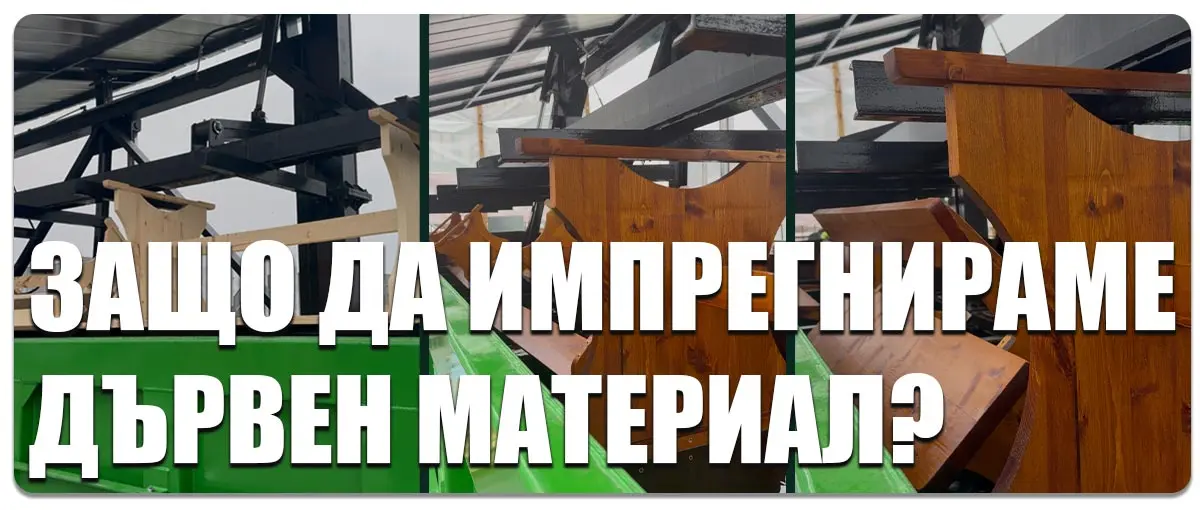
The timber is stacked into packs with cross battens between the rows so every face is exposed, then lowered fully beneath the surface of the solution with a hydraulic arm. A standard dip takes 30 to 60 minutes. An extended immersion of 24 hours gives longer-lasting protection, with penetration of up to 3 mm.
Draining and drying
The packs are lifted and left to drain so excess liquid runs back into the tank, then stacked to dry with air moving between the boards. Timber that is bundled while still wet stains and can grow mould despite the treatment.
Final handling
Once dry the wood is checked, labelled and stored under cover until it ships.
How impregnation extends the life of wood
Decay needs three things: moisture, oxygen and a food source. You cannot remove the oxygen and you cannot change what wood is made of, so treatment works on the moisture and on making the food source unpalatable. Take the wood below the moisture level at which fungi can establish themselves and keep it there, and the biological attack simply does not start.
Choosing the right product
Match the product to the exposure, not to the price list. Timber in contact with the ground or with standing water needs a different specification from cladding under an eave. Ask what hazard class the treatment is intended for, whether the wood will be painted afterwards, and whether it will be in contact with food, animals or drinking water — each of those rules some products out.
Where it pays off in practice
- Fences, pergolas and decking — permanently exposed, and the first things to fail untreated.
- Roof battens and structural timber — hidden, expensive to replace, worth protecting.
- Pallets and packaging stored outdoors — where mould means the load is rejected.
- Agricultural buildings — high humidity and constant condensation.
Have your timber treated
G-PAL impregnates timber in its own dipping tank in Plovdiv, whether the wood comes from us or from you. Call +359 877 166 555 or email [email protected]. See the price list.

