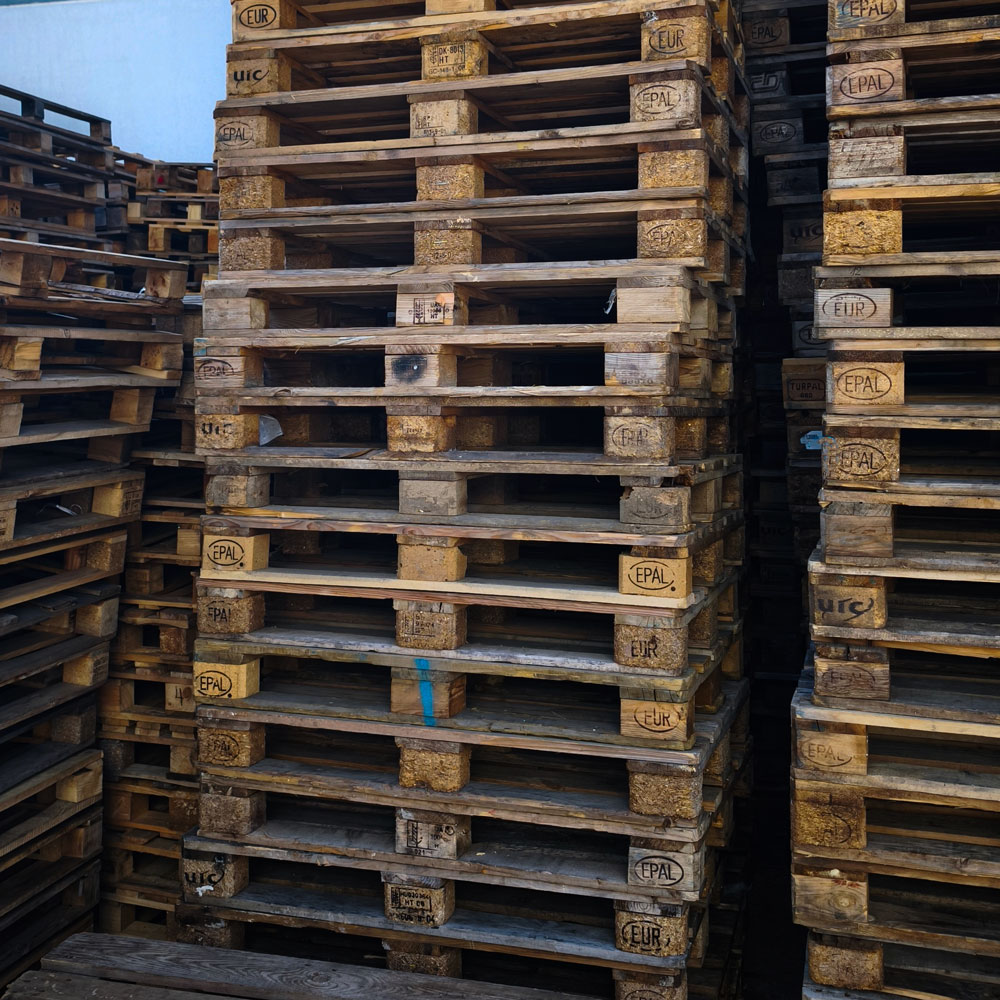
Surplus pallets sitting in a yard are money doing nothing, and they get worse the longer they stay there. Selling them back is straightforward once you know what a buyer actually looks at. Here is what gets bought, what sets the price, what gets refused, and how a deal runs from enquiry to payment.
What we buy
- EPAL and UIC euro pallets — 1200×800 mm, stamped on the corner blocks. This is the item with the highest and steadiest price.
- Industrial pallets — 1200×1000 mm and other established sizes.
- One-way and non-standard pallets — accepted, but priced on size and condition rather than on a standard.
- Wooden skids, lids and collars.
- Pallets for repair — a broken board or block is no reason to scrap them.
Condition grades — this is what sets the price
| Grade | Condition | Typical use |
|---|---|---|
| A (white) | Lightly used, light-coloured wood, no repairs, clean | Food and pharmaceutical industry, export |
| B (brown) | Visibly used, darkened wood, possible workshop repair, all elements sound | General warehousing and transport |
| C | Repaired and worn, but structurally sound | Internal movement, one-way trips |
| For repair | Broken board or block, the rest sound | Rebuilt in the workshop and returned to service |
What the price depends on
- Type and standard — a stamped EPAL pallet is worth more than a non-standard one of the same size.
- Condition grade — per the table above.
- Quantity — at a few hundred units the price per pallet improves, because the transport is spread across more of them.
- Location — the distance to the workshop goes into the sum. That is why it pays to look for a buyer who covers your area.
- Loading access — a ramp and a forklift on site speed the job up; hand-loading from a yard makes it dearer.
- Market conditions — demand for used pallets moves with exports and construction, and it is seasonal.
What we do not accept
- Mould and rot — dark patches and wood that feels soft. Wet pallets under plastic sheeting go mouldy within weeks.
- Contamination with oil, chemicals or paint — it cannot be cleaned off, and it rules the pallet out of food and export work.
- Burnt or charred wood.
- Missing or broken blocks combined with broken load-bearing boards — the repair costs more than the pallet.
- Severe distortion from soaking and then drying out.
How the deal works, step by step
- Enquiry. You send the type, an approximate number, the location and two or three photographs.
- Offer. You get a price per unit by grade, and the terms for transport.
- Arranging collection. Day, time and method of loading. At sufficient quantity the transport is at the buyer’s expense.
- Counting and acceptance on site. The number and the grades are confirmed together with you before the lorry leaves — this is the moment that settles any dispute.
- Paperwork and payment. Companies get an invoice or a handover protocol; payment is by bank transfer or in cash, as agreed.
Five things that raise your price
- Sort them beforehand. Separate EPAL from non-standard, and sound pallets from those needing repair. An unsorted heap gets quoted at the lowest grade in it.
- Keep them dry. Under a roof, or at least on bearers rather than straight on the ground. Moisture is the commonest reason for a refusal.
- Do not repair them yourself. A nail from the garage and a random board invalidate the marking and drop the pallet a grade.
- Stack them evenly, 20–25 to a stack. It makes counting and loading easier and shortens the time on site.
- Build up a quantity. One collection of 300 pallets is worth more than three collections of 100.
Private individuals and companies
We buy from both. A company gets an invoice or a handover protocol and can settle by bank transfer; a private seller can be paid in cash on collection. The grading and the pricing are the same either way — only the paperwork differs.
Buy-back and purchase at the same time
Plenty of customers sell us worn pallets and buy sound ones on the same visit. It is the cheapest way to refresh a pallet pool: one journey, one set of paperwork, and the value of the old stock comes straight off the price of the new.
G-PAL buys pallets across Bulgaria
We buy second-hand pallets and arrange delivery throughout Bulgaria with our own vehicles. Send the type, the quantity and your location through the contact page, or call +359 877 166 555, and you will have a price the same working day.

