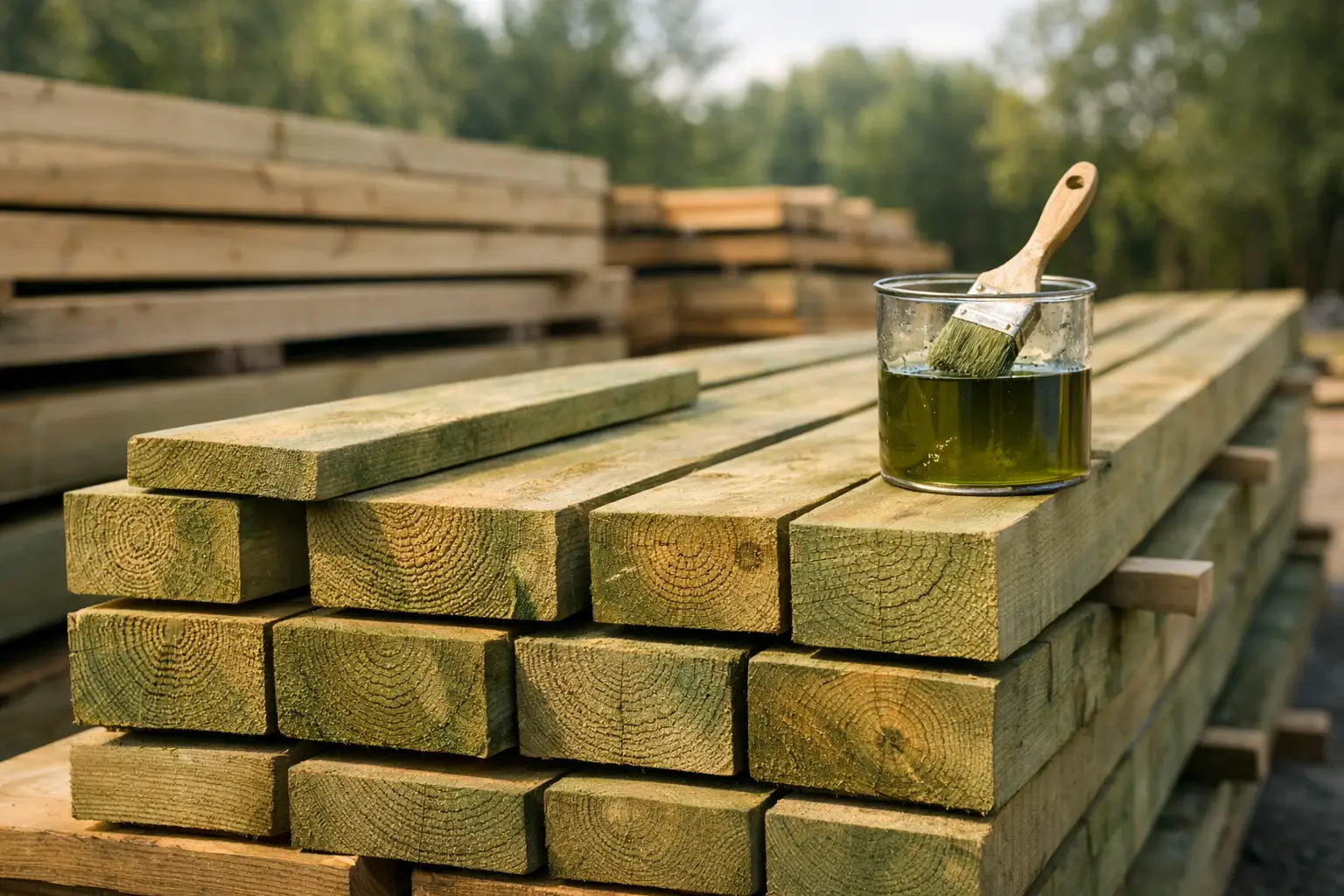
Dip impregnation in our own tank in Plovdiv – the price is for the day, on request: send the volume in cubic metres, the cross-sections and what the timber is for to +359 877 166 555 or via Viber/WhatsApp.
We reply to every inquiry with a price within 15 minutes.
Impregnated timber is worth it when the wood will be outdoors, close to the ground or in a damp room – that is where it protects against rot, fungi and insects. For a dry indoor space it is often unnecessary. G-PAL impregnates timber by dipping it in our own tank in Plovdiv.
Updated: 12 October 2026 · G-PAL (Dzhipal Ltd), Plovdiv
When timber is going to stand outdoors, absorb moisture or face heavy use, price is not the first question. The first question is how long it will last without warping, rotting or running up needless replacement costs. This is exactly where impregnated timber has a real advantage – not as a marketing promise, but as a practical solution for businesses that want a predictable result.
For storage yards, fencing, support elements, timber structures, transport packaging and some production applications, choosing between untreated and treated timber is no mere formality. If conditions are dry and controlled, standard timber is often sufficient. If there is moisture, outdoor storage or constant exposure to the weather, impregnation usually saves you problems from the very start.
What is impregnated timber?
Impregnated timber is wood treated with protective substances that penetrate its structure and increase its resistance to moisture, fungi, mould, insects and premature ageing. The aim is not to make the wood indestructible. The aim is for it to perform longer and more reliably in an environment where untreated timber deteriorates faster.
It is important to distinguish between surface application and true impregnation. With surface treatment, protection is more limited and depends heavily on how quickly the coating wears off. With more thorough impregnation, the protective agent penetrates deep into the wood, which matters for outdoor use and more intensive loads.
For business customers, this is no minor technical detail. If the timber is used for structural or packaging purposes, its durability and predictable behaviour over time have a direct impact on costs, safety and the pace of work.
When impregnated timber is the right choice
Most often, this material is justified when the wood will be exposed to fluctuating humidity, rain, condensation, sharp temperature changes or contact with an environment that accelerates wear. This applies to outdoor structures, timber elements in yards and depots, fencing, packing and auxiliary elements in construction, as well as to some industrial applications.
In logistics and warehousing, too, there are cases where impregnation is a sensible step. If timber elements or packaging are kept outdoors, moved frequently and exposed to moisture, treatment can extend their service life. This is especially important when it comes to regular deliveries and recurring costs.
There are also cases where paying more is not worth it. If the timber will be used in a dry indoor workshop, for a short-term project or for indoor applications with no moisture, standard timber may be the more sensible choice. Good judgement here means not overpaying for protection that will never actually be put to use.
Where it is most commonly used
In construction, impregnated timber is sought after for external frames, cladding, temporary structures, roofing elements and areas where moisture is a constant factor. For fences, canopies, gazebos, decking structures and garden solutions, treatment is almost a standard requirement if a longer service life is expected.
In production and logistics, the application is more pragmatic. There, the question is not how the wood looks, but how stable it remains under load, in storage and in transit. For skids, timber packaging, auxiliary load-bearing elements and specific custom solutions, treated timber often offers better durability over time.
With pallet and packaging solutions, one further point needs to be made. Not every treatment is the same, and not every treatment is suitable for every market or application. For exports, specific standards and certified requirements, it is important to work with a supplier who knows the details, rather than one who simply sells timber cut to size.
The main benefits – and the real limitations
The biggest benefit is a longer service life in difficult conditions. That means fewer replacements, fewer interruptions and more predictable cost planning. When the same element is used over a long period, even a small difference in durability can deliver tangible savings.
The second benefit is better protection against biological attack. Fungi, mould and insects are not an abstract risk, especially with outdoor storage or moisture. With untreated wood, the problem often becomes visible late – when the structure has already been weakened.
The third benefit is more trouble-free use. For businesses, this means fewer emergency fixes and fewer questions along the lines of “why didn’t this timber last?”. When the wood is chosen correctly for the conditions, the work process is more predictable.
But there are limitations, too. Impregnation does not remove the need for proper storage, sound construction and correct installation. If the timber sits directly in standing water, has no ventilation or is loaded incorrectly, the protection will not solve everything. In addition, the price is usually higher, and this investment does not pay off on every project.
How to choose the right timber for your project
First, look at the environment, not just the size. Will there be direct rain, condensation, mud, a wet floor, outdoor storage or contact with soil? If the answer is yes, impregnation should be seriously considered right at the ordering stage.
Next, assess the function. It is one thing for the wood to serve as a temporary auxiliary element, and quite another for it to bear a load or form part of a structure on which day-to-day work depends. The more important its role, the less room there is for compromise on quality.
The volume you order matters as well. For one-off quantities, the decision is sometimes easier. For regular deliveries to a production site, construction site or logistics depot, it is important to ensure consistency in specifications, treatment and lead times. Here, a reliable supplier is just as important as the timber itself.
The practical approach is to clarify the dimensions, application, environment, required treatment and delivery frequency in advance. That way the quote is a real one rather than an estimate, and the risk of making the wrong choice is lower.
What to ask your supplier before ordering
If you are looking for impregnated timber for business use, ask a few specific questions. What type of treatment is used, what use is the timber suitable for, what is its moisture content, what are the dimensional tolerances, and are regular deliveries of consistent quality possible? This avoids misunderstandings, especially when the timber goes straight into production or onto a site.
It is also worth clarifying how it will be transported and stored after delivery. Even good-quality timber can lose some of its advantages if it is left in unsuitable conditions straight after unloading. With larger quantities, logistics is not a secondary matter but part of the solution itself.
For customers in Plovdiv and the surrounding region, the greatest advantage is often a quick response and the ability to work with a supplier who keeps stock and understands the real needs of the business. GPAL is sought out in precisely these situations – when, beyond the timber itself, lead time, reliability and clear communication also matter.
Price versus real value
The cheapest timber is rarely the most cost-effective when it is used in harsh conditions. If early replacement, extra labour, delays on site or problems in use follow, the initial saving quickly disappears. That is why, when choosing, it makes more sense to consider the total value over the period of use, not just the price per cubic metre or per piece.
This is particularly true for businesses with repeat processes. If you buy timber every month for the same activity, the cumulative effect of the right choice is significant. Less waste, fewer complaints and fewer replacements mean better control over costs.
When a project is short, indoors or involves limited loads, standard timber may be entirely sufficient. When conditions are harsh and the goal is a long service life, impregnation usually pays for itself. A good deal is not the one with the lowest price, but the one that saves you from buying again a few months later.
If you are undecided between treated and untreated timber, the most useful approach is to start from the real working environment rather than a general rule. The wood should match the load, the moisture and the service life you expect from it. When the choice is made correctly from the outset, the timber works for your business instead of creating extra tasks.
Frequently asked questions
When is impregnation needed?
For fences, beams, decking, pallets kept outdoors and anything exposed to moisture or close to the soil.
How do you impregnate timber?
By dipping it in our own tank, followed by draining and drying.
Do you impregnate customers’ own timber?
Contact us on +359 877 166 555 so we can confirm the type and quantity.
How much does impregnation cost?
The price depends on the volume and is for the day.
How much does impregnation cost and how do I get a price?
The price is for the day and depends on the volume in cubic metres, the cross-sections and the intended use of the timber. Send these three details to +359 877 166 555 or via Viber/WhatsApp and you will receive a quote. See also impregnation prices.
See also: impregnation, impregnation prices, pallet impregnation.
📞 Call: +359 877 166 555 · Viber · WhatsApp
See also: timber impregnation, impregnation prices, timber in Plovdiv.
Updated: 13 November 2026
About the author
depal
Pavel Damyanov is the manager of DZHIPAL Ltd (G-PAL) - a manufacturer and supplier of euro pallets, wooden skids and pallet collars based in Plovdiv, 270 Vasil Levski Blvd. The company is a licensed EPAL pallet repair operator (licence No. BG-308), buys back pallets and skids on site and delivers nationwide with its own transport.
Published on 24 April 2026
Need today's price? Tell us the pallet type, quantity and city and we will reply with today's price.
Request a price
