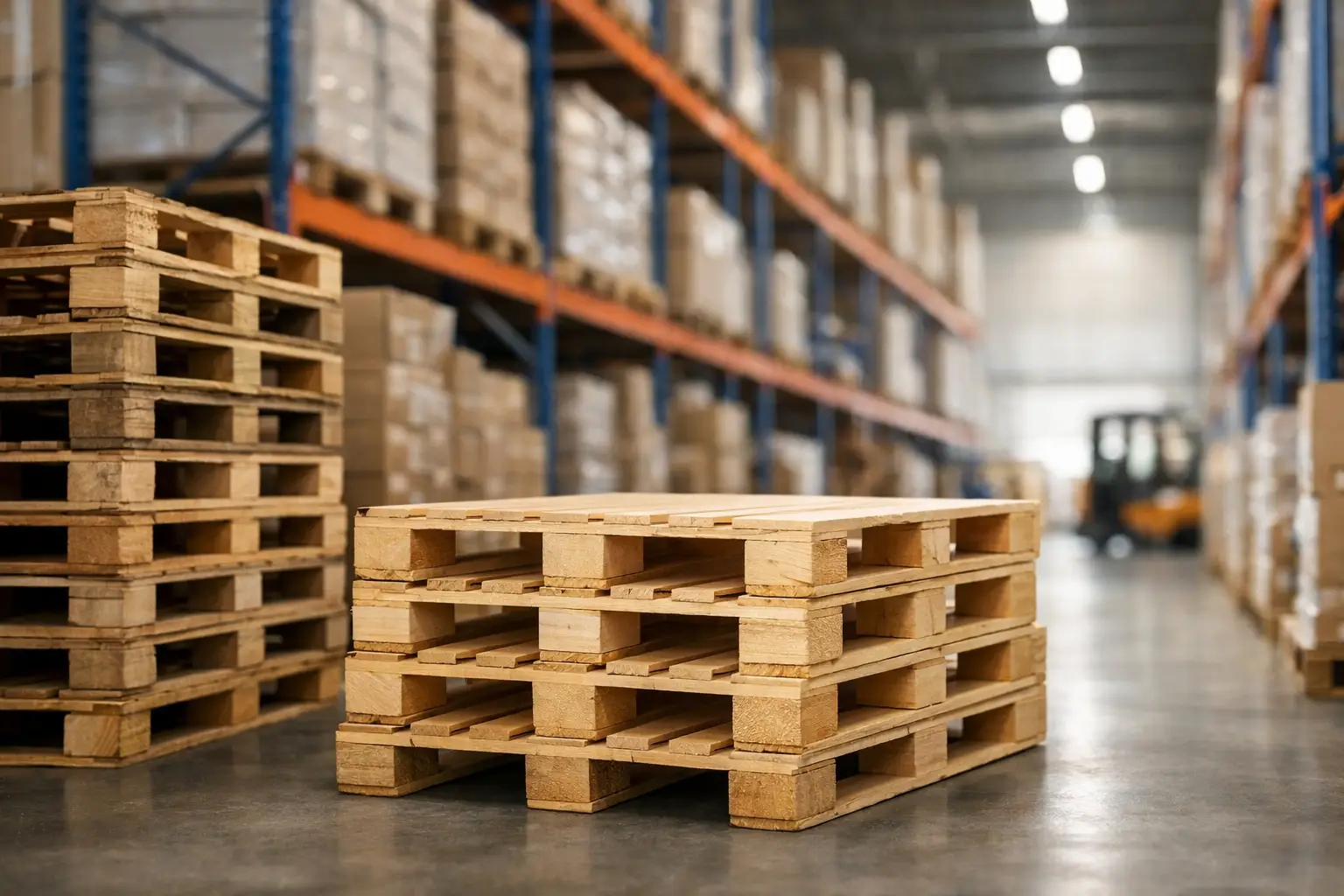
A wooden skid is what you order when a standard euro pallet does not fit the job — a different footprint, a different load, a rack that needs a solid base. Because a skid is made to order, the specification is yours to set, which is both the advantage and the place things go wrong. This is what to ask for.
Types of skid and what each is for
- Solid deck skid — boards laid edge to edge with no gaps, for fine or bulk goods that would fall through.
- Slatted skid — boards spaced apart. Lighter and cheaper, and the standard choice where nothing can fall through.
- Skid on blocks — a platform on feet, so a forklift can get underneath.
- Racking skid — sits on the beams of the racking and stays there; the load moves, the skid does not.
- Lid or slip sheet — a flat platform with no feet, used to protect or cap a pallet load.
Skid or euro pallet — when to use which
The euro pallet is a standard: 1200×800 mm, fixed construction, interchangeable anywhere in Europe. A skid is made to your drawing. Use the euro pallet when the goods travel through other people’s systems — hauliers, distribution centres, exchange pools. Use a skid when the dimensions, the load or the racking do not match the standard, or when the platform stays inside your own operation.
Sizes
The most commonly ordered footprints are 1200×800, 1200×1000 and 1200×1200 mm. For a racking skid the size is not chosen freely: it follows the clear distance between the load beams and the depth of the rack. Measure both before ordering, not after.
Material and sections
Skids are made of pine and spruce. The board thickness and the size of the bearers follow the load:
| Load | Boards | Bearers |
|---|---|---|
| Light, up to 500 kg | 20–22 mm | 80×80 mm |
| Medium, up to 1000 kg | 22–25 mm | 80×100 mm |
| Heavy, over 1000 kg | 30–40 mm | calculated individually |
Load capacity — how to read it properly
A single kilogram figure means very little on its own. Three things decide what a skid will actually carry:
- How the load is distributed. Evenly spread weight and a concentrated point load are not the same problem.
- What it sits on. A skid resting on a flat floor is supported along its whole length; one spanning two racking beams is not.
- Static or dynamic. Standing still is one figure; being lifted, moved and set down is a lower one.
So when you are quoted a capacity, ask which of the three it refers to.
Skids kept outdoors
- Use a slatted deck, not a solid one, so water drains and air moves through.
- Keep it off the ground on bearers.
- Have the timber impregnated — untreated wood outdoors has a short life.
If the skid leaves the EU, ISPM 15 applies and the wood must be heat treated and marked.
Five questions to settle before ordering
- What are the external dimensions, and are they fixed by racking?
- What is the load, and how is it distributed?
- Solid deck or slatted?
- Indoors or outdoors — does it need impregnation?
- Will it leave the EU?
Answer those five and a quote takes minutes instead of days.
Order wooden skids
G-PAL makes skids to order in Plovdiv and delivers across Bulgaria with its own transport. Call +359 877 166 555 or email [email protected].

