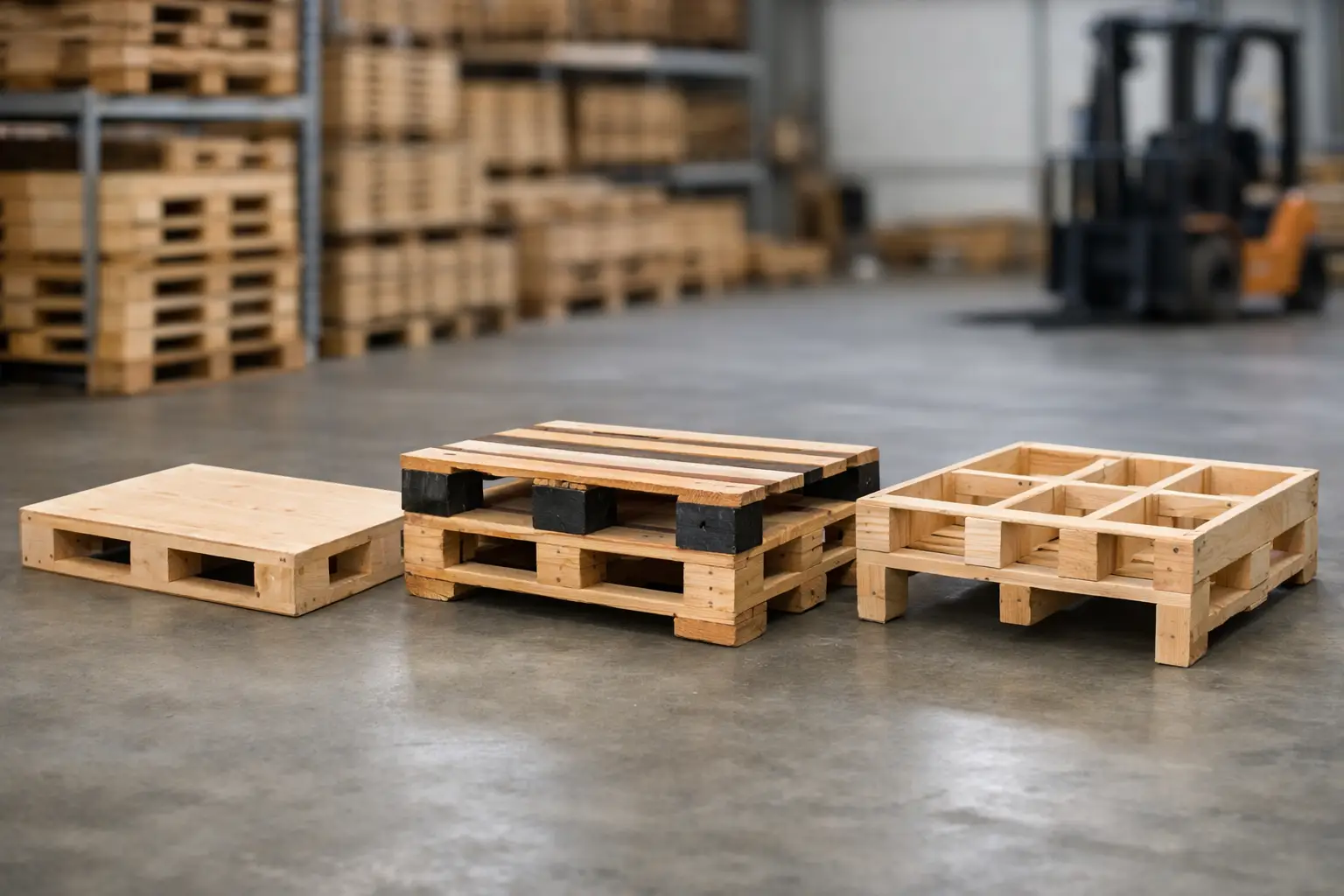
G-PAL makes pallets and skids in non-standard sizes to order – built to the size and weight of your load. Tell us the length, width, load weight, quantity and whether the goods are for export (in which case the pallets must comply with ISPM 15 (Standard 15)). The price is for the day and depends on size and quantity.
Updated: 12 October 2026 · G-PAL (Dzhipal Ltd), Plovdiv
When a standard pallet won’t fit the racking, can’t take the weight or leaves empty space in the truck, the costs soon mount up. In cases like these, custom non-standard pallets aren’t an extra expense – they’re a practical way to achieve safer transport, better storage and fewer losses along the supply chain.
In many production sites and warehouses, the problem isn’t the packaging itself but the base it sits on. Machine parts, metal products, cartons in unusual sizes, building materials, export goods or high-value items rarely fit a standard format perfectly. That’s when the pallet needs to be adapted to the load, not the other way round.
When custom non-standard pallets are the right choice
The most common warning sign is when standard sizes force a compromise. You see it in overhanging loads, uneven weight distribution, instability when stacking, or awkward handling with pallet trucks and forklifts. If these situations keep recurring, the standard pallet is no longer the economical option.
A non-standard size is also the right fit when you have to meet specific requirements for a production line, an automated warehouse, a loading dock or a customer specification. For export, too, there are cases where the size, board thickness or design must suit the loading method and the requirements for wood packaging.
There are purely commercial reasons as well. When a truck can carry more units thanks to an optimised pallet size, the transport cost per product falls. At high volumes, the difference is felt immediately.
What actually gets specified in a made-to-order pallet
A custom pallet isn’t just a matter of length and width. To perform well in everyday use, you need to define the load, how it’s stacked, which way the forks enter, the transport conditions and whether the pallet will be single-use or reusable.
Dimensions are the first step, but load capacity and design come next. A heavy, compact load calls for a different arrangement of boards and bearers than a bulky but light product. It’s equally important whether the load is static, dynamic or stacked several levels high.
The type of timber matters too. For some applications, price is the priority. For others, you need greater durability, better stability or treatment for export. If the pallet will be reused, a sturdier design usually pays off in the long run, even if the upfront price is higher.
Size alone doesn’t solve everything
A common mistake is ordering a pallet based on external dimensions alone. In practice, this can cause problems if load capacity and the working environment aren’t taken into account. A pallet that’s the exact size but not strong enough creates a risk of breakage, shifting during handling and damage to the goods.
The same applies the other way round. An overly heavy and expensive design isn’t always right either. If the pallet is for a one-off delivery or a lighter load, there’s no sense in paying for surplus material. Good made-to-order work strikes a balance – sufficient strength, a reasonable price and genuine suitability for the specific operation.
Custom non-standard pallets built around the load
For industrial customers, the most practical approach is to design the pallet around the actual load. That means not just kilograms, but also the shape of the product, the pressure points and how the goods sit on the base.
For cartons and packaged goods, the aim is usually an even bearing surface and good use of space. For machinery, metal components or parts with concentrated weight, the design must carry the load without twisting. For building materials, the combination of strength and suitability for outdoor storage and frequent handling is often what matters.
It also matters whether the pallet will be stretch-wrapped, secured with straps or combined with pallet collars. When all these details are planned in advance, the load stays more stable and warehouse handling becomes quicker.
What a business gains from a properly made pallet
The first benefit is less damage. When the base suits the product, the goods don’t sag, don’t shift easily and cope better with handling, transport and stacking. This is especially important for fragile, expensive or hard-to-replace items.
The second benefit is better warehouse organisation. If the size suits the racking, floor positions and handling equipment, handling is easier and space is used more efficiently. It may not sound like a big change, but with constant throughput it adds up to real time saved.
The third benefit is better logistics planning. An optimised pallet allows clearer calculation of load units, better vehicle fill and less improvisation at dispatch. For companies with regular deliveries, this is an important operational difference.
Where compromises most often arise
Not every order needs a complex design. Sometimes a slight adjustment to the size or material thickness is enough. In other cases, however, chasing the lowest price leads to a weak pallet that only holds up in theory. If you cut corners on key components, the risk shifts onto the load.
Another compromise is lead time. With urgent orders, it’s sometimes necessary to use available materials and a size close to the one required. That can be perfectly reasonable if the application allows it. But for repeat production or contracted deliveries, it’s better to fix the size and design clearly from the outset.
Batch size matters too. Made-to-order production is possible for single quantities, but the unit price will naturally differ from that for regular volumes. When a customer has a predictable monthly requirement, both production and delivery can be planned more efficiently.
What a good enquiry looks like
The most useful enquiry starts with real data, not just an approximate size. It helps to specify the dimensions and weight of the goods, whether the load is evenly distributed, how it’s moved and stored, and whether the pallet must meet export requirements.
If there’s a drawing, photo or sample, the process becomes quicker and more accurate. If not, an experienced supplier can propose a workable configuration based on the application. This is exactly where the difference between a simple sale and genuine advice shows.
For companies working with steady quantities, it makes sense to plan not just production but also regular stock availability and transport. This reduces downtime and makes supply more predictable. For businesses in Plovdiv and the surrounding region, a quick response is often just as important as the price itself.
The importance of treatment and certification
When pallets are used for international shipments, the timber often has to be treated in accordance with ISPM 15 (Standard 15). This isn’t a formality but a requirement that can halt a shipment if it isn’t met properly. That’s why it should be clear from the initial enquiry whether the pallets will be used for export.
For some applications, impregnation also matters, especially if the pallets will be kept in damp conditions, outdoors or used over a longer period. Here, the choice depends on the environment and how many work cycles are expected. There’s no one-size-fits-all option.
How to recognise a reliable supplier
A good price matters, but on its own it isn’t enough. With non-standard solutions, consistent quality, the ability to repeat a specification and clear communication on lead times and parameters are what count. If each pallet differs from the last, the problem will sooner or later reach the warehouse or the customer.
A reliable partner asks the right questions from the start. They want to know what the load is, how it’s handled and what the pallet needs to withstand. They don’t promise everything at any price – they offer a solution that can be delivered properly and on time.
This is especially important for companies looking not for a one-off purchase but for dependable supply. In practice, the best results come when the supplier understands the specifics of the business and can respond quickly to changes in volumes, sizes or schedules. That’s exactly why many companies choose to work with a partner like GPAL when they need a combination of manufacturing, stock availability and transport.
A non-standard pallet isn’t a special product for rare cases. For many production and logistics operations, it’s the most sensible foundation for safer working, less damage and better cost control. When the size, design and treatment are matched to the actual load, the pallet stops being a consumable and starts working for the business.
The exact euro pallet dimensions (1200 × 800 × 144 mm, around 25 kg) and load capacity are set out on a separate page. Today’s price on +359 877 166 555.
Checklist for a custom pallet order
- External dimensions – length and width in millimetres; measure the base of the goods and add a small margin.
- Height limit – for example because of racking or the trailer.
- Load weight per pallet – and whether it is evenly spread or concentrated at specific points.
- How it is lifted – forklift, pallet truck or crane; this decides two-way or four-way entry.
- Quantity – a one-off batch or a regular order with a fixed size, design and marking.
- Destination – goods leaving the EU need pallets treated and marked to ISPM 15 (Standard 15).
- Damp storage – skids and pallets kept outdoors or in a basement can be impregnated in our own dip tank.
Send a drawing or a photo with dimensions via Viber or WhatsApp to +359 877 166 555. Besides pallets and skids, our yard at 270 Vasil Levski Blvd in Plovdiv stocks timber – beams, boards, planks and cladding. We deliver with our own trucks across Bulgaria; in Plovdiv and Plovdiv Province on the day the order is ready. On the same run we can collect your old pallets, standard or non-standard, and deduct their value from the bill. G-PAL also repairs euro pallets under EPAL licence BG-308.
Frequently asked questions
What sizes do you make?
Any size, depending on the load. Tell us the length, width and height, or send us a drawing.
Can a non-standard pallet be used for export?
Yes, provided it is treated and marked in accordance with ISPM 15. We work with manufacturers certified to ISPM 15 (Standard 15).
Is there a minimum order quantity?
There is no fixed minimum. The price depends on size and quantity.
How much does a custom pallet cost?
The price is for the day. Call +359 877 166 555.
How much does it cost to have pallets made to order?
The price is for the day and depends on size, load, timber and quantity. Send the dimensions, load weight, quantity and whether the pallets are for export to +359 877 166 555 or via Viber/WhatsApp, and you’ll receive a price and lead time. For the standard size: a new EPAL pallet is from €16.20, a used one from €7.00.
What information do you need to quote a custom pallet?
The external dimensions in millimetres, any height limit, the load weight per pallet and how it is spread, how the pallet is lifted (two-way or four-way entry), the quantity, and whether the goods leave the EU. A drawing or photo helps.
Does impregnation replace ISPM 15 treatment for export?
No. Impregnation in our dip tank protects skids and pallets kept in damp places; ISPM 15 heat treatment and marking are required for export outside the EU. They are two different things.
Is there an alternative to a custom pallet for loose goods?
Often yes: a standard 1200×800 euro pallet with pallet collars (frames) turns into a crate. Pallet collars are from €10.20.
Do you deliver custom pallets outside Plovdiv?
Yes, with our own trucks across Bulgaria. The delivery price depends on distance and quantity, and there is no fixed minimum.
See also: pallet manufacturing, pallet sizes, skids made to size.
📞 Call: +359 877 166 555 · Viber · WhatsApp
About the author
depal
Pavel Damyanov is the manager of DZHIPAL Ltd (G-PAL) - a manufacturer and supplier of euro pallets, wooden skids and pallet collars based in Plovdiv, 270 Vasil Levski Blvd. The company is a licensed EPAL pallet repair operator (licence No. BG-308), buys back pallets and skids on site and delivers nationwide with its own transport.
Published on 29 April 2026, updated on 22 November 2026
Need today's price? Tell us the pallet type, quantity and city and we will reply with today's price.
Request a price
