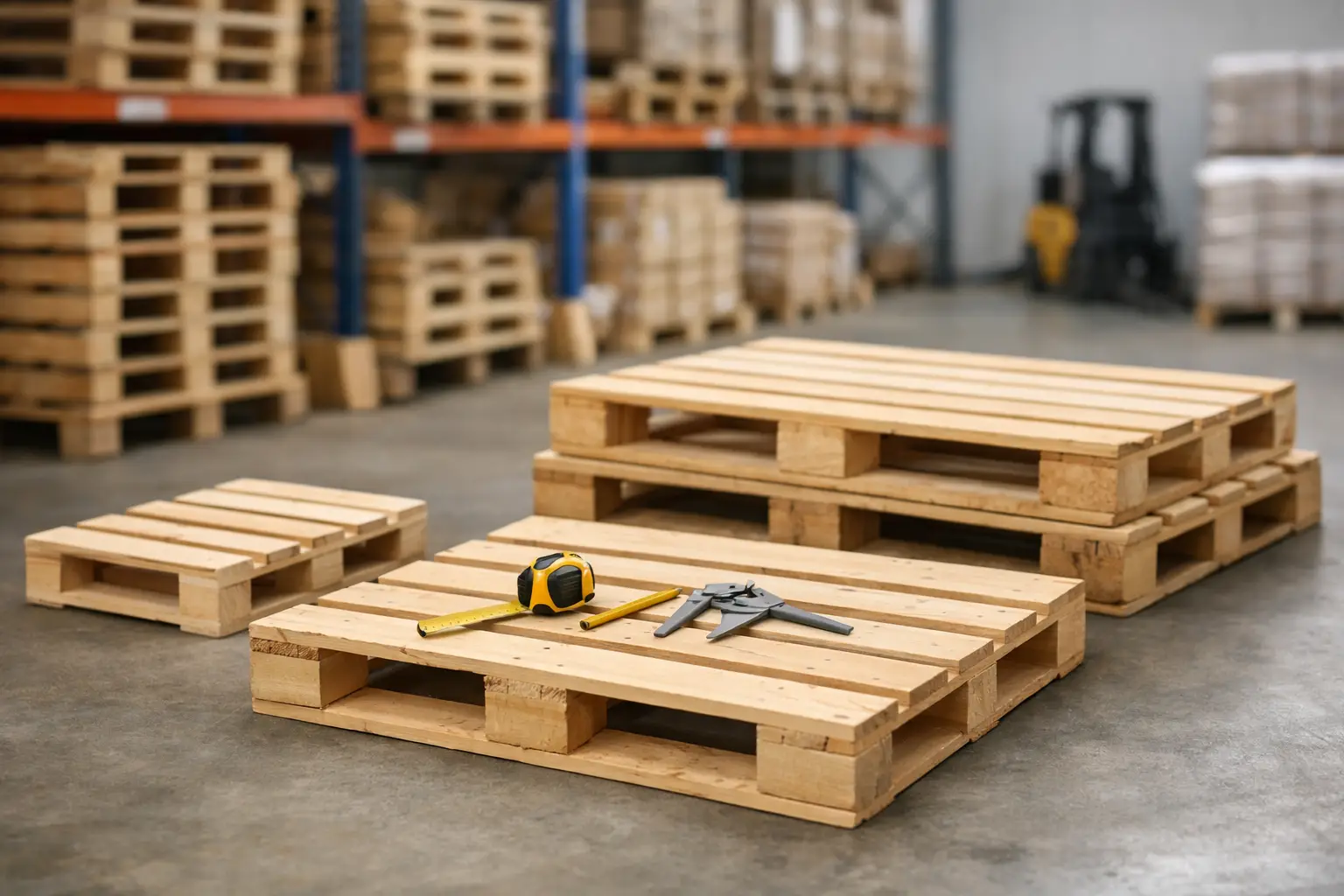
The size of the skid follows the load: the standard euro skid is 120×80 cm, and for other loads G-PAL makes skids in non-standard sizes to order. The load should not overhang the skid by much, and the entry points must suit your forklift. Give us the size, weight and quantity on +359 877 166 555.
Updated: 12 October 2026 · G-PAL (Dzhipal Ltd), Plovdiv
When skids don’t fit the goods, the problem isn’t just awkward stacking. You lose warehouse space, load less efficiently, increase the risk of damage and often pay more for transport. That is why choosing pallet skids by size is not a minor detail but a direct decision in favour of better logistics, safer storage and more predictable costs.
For standard loads, a standard skid is often enough. But when you work with non-standard cartons, heavy components, specialist machinery or products with an unusual footprint, size starts to matter. That is exactly when a tailored solution saves time, re-stacking and unnecessary compromises.
When pallet skids by size are the right solution
There are cases where a standard euro pallet does the job perfectly well. If the load is uniform, palletising is predictable and the warehouse is organised around standard sizes, there is no reason to complicate the process. In day-to-day operations, however, loads that fall outside the standard frame come up all the time.
This happens with long or wide items, with goods in unstable packaging, with production runs in a repeatable but non-standard format, and with exports, where every deviation in dimensions affects how the load fits in a truck or container. In situations like these, a pallet skid made to exact size is not a luxury but a practical operational measure.
Made-to-size skids are also in demand when a company wants to reduce empty space around the load. A more compact base means better use of warehouse floor space, easier stacking and less movement of goods on the skid itself. This is particularly important for fast-moving goods and for internal logistics with intensive handling.
What actually determines the right size
Size is not just about length and width. In practice, you need to consider the dimensions of the goods, the loading method, the expected load and the equipment that will handle the skid. If any of these factors is overlooked, you risk ending up with a product that is accurate on paper but causes problems in day-to-day use.
Load dimensions and acceptable overhang
The first question is simple – what are the actual dimensions of the product or packaging? Not approximate, but actual. With cartons, sacks, crates or irregularly shaped items, even a small discrepancy can lead to instability.
Sometimes a slight overhang is acceptable. Sometimes it isn’t. If the load is fragile, heavy or moved frequently, it is better for the base to support it properly. If the aim is to make the most of the available space and the load is well secured, a minimal overhang beyond the outline may be acceptable. This depends on the specific operation, not on a universal rule.
Load capacity and construction
Two pallets of the same size can behave quite differently under load. The reason lies in the thickness of the boards, the number of supporting elements, the type of joints and the overall construction. If the size is increased but the construction isn’t designed for the load, the skid may sag, twist or fail under dynamic loading.
That is why, when ordering pallet skids by size, you should always specify not only what will be placed on top, but also how much it weighs, how the weight is distributed and whether the load sits evenly. There is a difference between palletised cartons, metal parts and a machine with concentrated loading at a few points.
Forklift and warehouse equipment compatibility
The size of the skid must also suit the equipment in your warehouse or production facility. The fork entries, the height of the structure and the direction of entry are all part of the practical design. If this isn’t planned properly, handling becomes slower and the risk of breakage increases.
With narrow aisles, specific racking or frequent handling with electric pallet trucks, dimensional accuracy is even more important. There, a non-standard skid must not only carry the load but also fit into the entire logistics process.
Pallet skids by size for different applications
In production, the most common requirement is for sizes tailored to a specific product or production cycle. The goal is for the load to be stacked quickly, safely and without additional securing. When the same item moves every day, the right skid saves time at every step.
In warehousing, the focus is usually on optimising floor space. Here, the right size can improve racking layout, reduce the number of mismatched formats and make stocktaking easier. This is especially useful with mixed goods and smaller batches.
In transport and distribution, the choice is often determined by the dimensions of the vehicle and the way the load is grouped. If the skids are well chosen, more units fit per trip and the load stays more stable. If they aren’t, useful volume is lost and costs per unit go up.
In construction and the building materials trade, loads are often heavier, longer or more awkward to handle. There, a non-standard size is a common solution, because materials rarely fit perfectly into a standard format.
New or used skids by size
Here the choice depends on the application. If the skid is part of a closed internal loop, doesn’t need to meet high standards of appearance and is used for internal movement, used options are sometimes a sensible choice. They can be economical, provided the quality has been checked and the condition matches the load.
When it comes to a specific size, repeat deliveries or higher strength requirements, new production is usually the better choice. It gives you control over dimensions, construction and compatibility with your specific operation. For exports or sensitive loads, this is often the right way to go.
It is also important to think long term. The lowest price per unit doesn’t always work out cheapest if the skids get damaged quickly, make loading harder or cause damage to the goods.
How to submit an accurate order
The best results come when the enquiry is specific. State the length, width and, if necessary, height. Add what load will be placed on the skid, the approximate weight, whether the load is evenly distributed and how the skids will be handled – with a forklift, a hand pallet truck or another type of equipment.
It also helps to specify where they will be used – in a warehouse, in production, outdoors, in transport or in a closed loop. If there is a requirement for a particular standard, impregnation or specific treatment, this should be stated in advance. The clearer the parameters, the more accurately and quickly a solution can be proposed.
For companies with a steady flow of identical goods, it also makes sense to consider batch production. This ensures consistent dimensions and makes stock planning easier. For businesses in Plovdiv and the surrounding region, there is another practical advantage – a shorter response time when the supplier is genuinely close to the site.
Common mistakes when choosing a size
The most common mistake is ordering “by eye”. This leads to a mismatch between the expected and the actual load. The second mistake is looking only at the base area without taking the construction into account. The third is failing to think about the whole cycle – storage, moving, loading and return.
Another issue also comes up – a company chooses an overly universal size in the hope that one skid will do everything. In practice, this often doesn’t work well. If products differ in dimensions and weight, it is sometimes more efficient to use two or three clearly defined formats instead of one compromise solution.
What you gain from the right choice
Well-chosen pallet skids by size offer more than convenience. They improve stacking, speed up handling and reduce the risk of damage to goods. With larger volumes, this effect shows clearly in warehousing, transport and staff time costs.
What’s more, the right size brings predictability. And in logistics and production, predictability has real value. When you know how the goods stack, how many units fit in one trip and how the load behaves when moved, planning becomes easier.
GPAL works on exactly this principle – practically, clearly and with a focus on a solution that can be used every day, not one that only looks good on a specification sheet. If you are choosing skids for a specific operation, the best approach is to think not only in centimetres but in terms of the real working process. That way, size starts working for your business rather than against it.
Questions about skids by size
What is the standard size of a euro skid?
120×80 cm, the same as a euro pallet.
Do you make skids to our size?
Yes, skids in non-standard sizes too, made to order.
What should I tell you when ordering?
The size, the weight of the load, the quantity, whether they will go on racking or for export, and the delivery address.
How much does a made-to-size skid cost?
The price is for the day and depends on size and quantity. Call +359 877 166 555.
See euro skids, wooden skid prices, pallet production, types of skids.
📞 Call: +359 877 166 555 · Viber · WhatsApp
About the author
depal
Pavel Damyanov is the manager of DZHIPAL Ltd (G-PAL) - a manufacturer and supplier of euro pallets, wooden skids and pallet collars based in Plovdiv, 270 Vasil Levski Blvd. The company is a licensed EPAL pallet repair operator (licence No. BG-308), buys back pallets and skids on site and delivers nationwide with its own transport.
Published on 20 April 2026
Need today's price? Tell us the pallet type, quantity and city and we will reply with today's price.
Request a price
