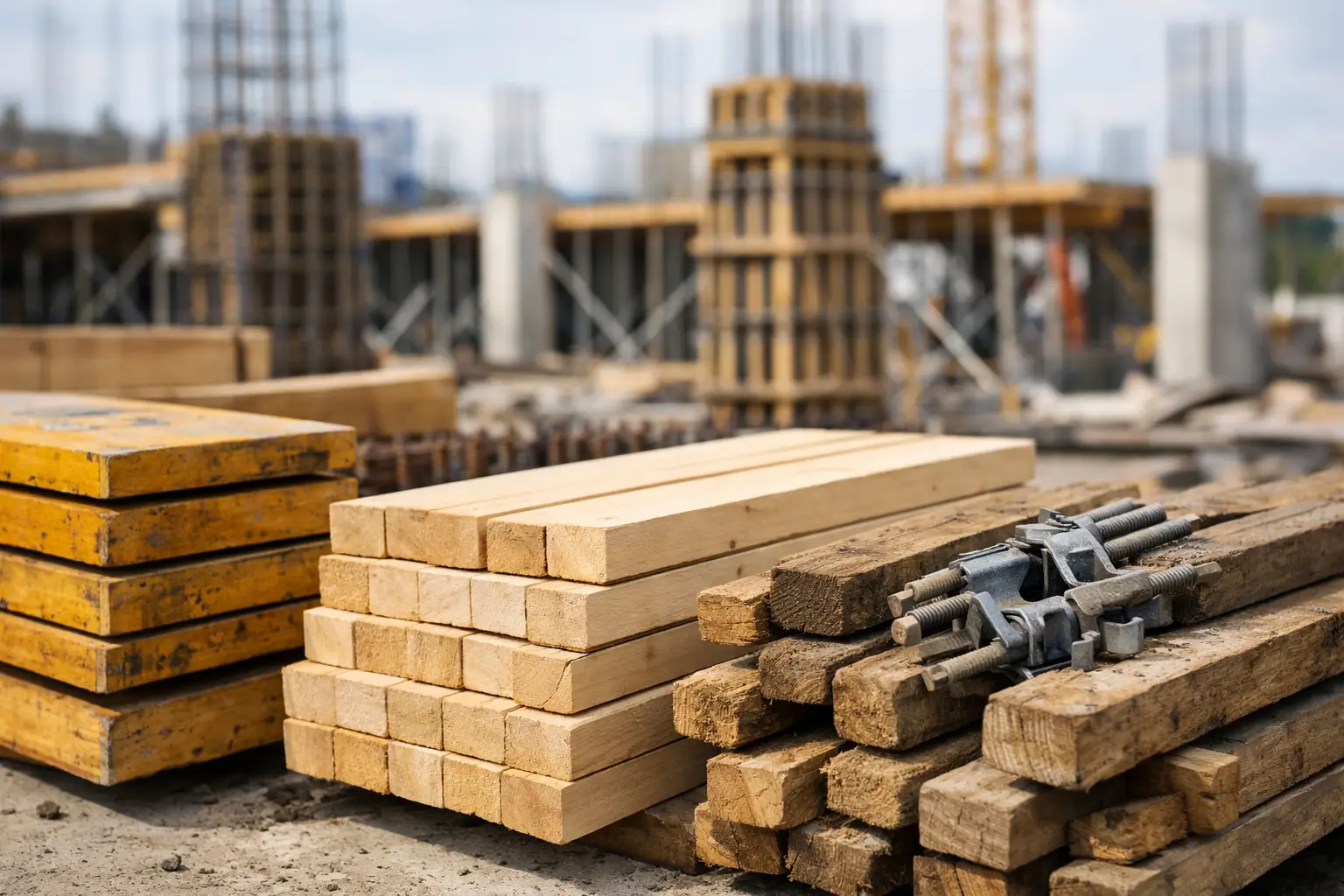
Ordering timber is easy to get wrong, because two boards with the same nominal size can behave completely differently once they are in place. What decides that is the processing, the species and above all the moisture content. Here is what to specify and what to check when the load arrives.
Types by processing
- Unedged (sawn) timber — the side edges still carry bark. The cheapest option, fine for formwork and scaffolding.
- Edged timber — a true rectangular section with the edges cut off. The standard for structures and packaging.
- Planed and calibrated — smooth faces and precise dimensions, for visible elements, cladding and frames.
- Kiln-dried — dried to a controlled moisture content in a chamber. More expensive, and far more stable.
- Impregnated — chemically protected for outdoor use.
Softwood or hardwood
- Pine — light, easy to work, and it takes impregnant well.
- Spruce — lighter and stiffer than pine, but it resists absorbing treatment.
- Oak and acacia — hard and moisture-resistant, the right choice for posts and outdoor structures, and considerably more expensive.
Moisture — the parameter that decides everything
| State | Moisture | What it is good for |
|---|---|---|
| Freshly felled | over 40% | unusable — it will warp and split |
| Air-dried | 15–20% | formwork, scaffolding, packaging, rough structures |
| Kiln-dried | 8–12% | frames, cladding, furniture, visible elements |
If you specify nothing else, specify this. Moisture is the difference between a board that stays straight and one that twists a fortnight after it is fixed.
Standard sections
- Boards: 20, 25, 30, 40 and 50 mm thick.
- Planks: over 50 mm.
- Beams: 100×100, 120×120, 150×150 mm.
- Battens: 30×50 and 50×50 mm.
- Lengths: 2 to 6 m, usually in 0.5 m steps.
Timber for formwork
- Thickness: 21–25 mm for boards at normal support spacing; 30–50 mm for wider spans.
- Moisture: air-dried is the right specification here.
- Re-use: formwork oil before every pour roughly doubles the life of the boards.
Timber for packaging and pallets
Aim for around 18–22% moisture. Drier than that and the wood splits when it is nailed; wetter and it grows mould in transit. For export outside the EU the timber has to be heat treated and carry an ISPM 15 mark.
How to order correctly
Timber is traded by the cubic metre, not by the board. Work out the volume before you ask for a price: a board 0.025 × 0.15 × 4 m is 0.015 m³, so 100 of them make 1.5 m³. Quoting a volume gets you a comparable price from every supplier; quoting a number of boards does not.
What to check on delivery
- The actual dimensions. Take a tape to random pieces from different packs, not from the top of one.
- The moisture. Use a meter. Judging by hand tells you nothing useful.
- Warp. Lay a board on a flat surface and sight along it from the end.
- Knots. Large, dark or loose knots in the middle of a board take a serious bite out of its strength.
- Blue stain and mould. Both mean the timber was stacked wet, and both will get worse, not better.
Buying timber
G-PAL supplies timber and impregnates it in its own dipping tank in Plovdiv. Call +359 877 166 555 or email [email protected]. More on wood impregnation.

